

Listen to Audio “Deep Dive” Discussion.
Download The Discussion “Slide Deck.”

Here is a question I want you to sit with before we go any further.
Have you ever arrived at a solid, Scripture-grounded interpretation — one you traced through the cross-references yourself, one you prayed over, one the Holy Spirit seemed to confirm through multiple converging passages — only to have someone tell you that your conclusion is wrong? And in that moment, did you feel yourself lock up? Did your jaw tighten? Did a small, quiet voice inside you whisper, “I’m not interested in what they think. I did the work. I found it in the Bible. The text says what it says”?
If that has happened to you, I want you to know two things.
First — that impulse is understandable. You are not the first Truth Prospector to feel it.
Second — that impulse, if you let it govern you, will eventually make you dangerous.
Not to others. To yourself.
Because the moment you decided that your individual interpretation required no verification, no testing, no outside eyes — you became the soldier who went out on solo reconnaissance and convinced himself he didn’t need the unit anymore. And in every theater of war, across every generation of military history, that soldier’s story ends the same way.
The Tactical Situation: When Solo Reconnaissance Becomes a Liability
Let’s establish the military picture clearly before we move into the theology, because the analogy is not decoration — it is the interpretive key to everything that follows.
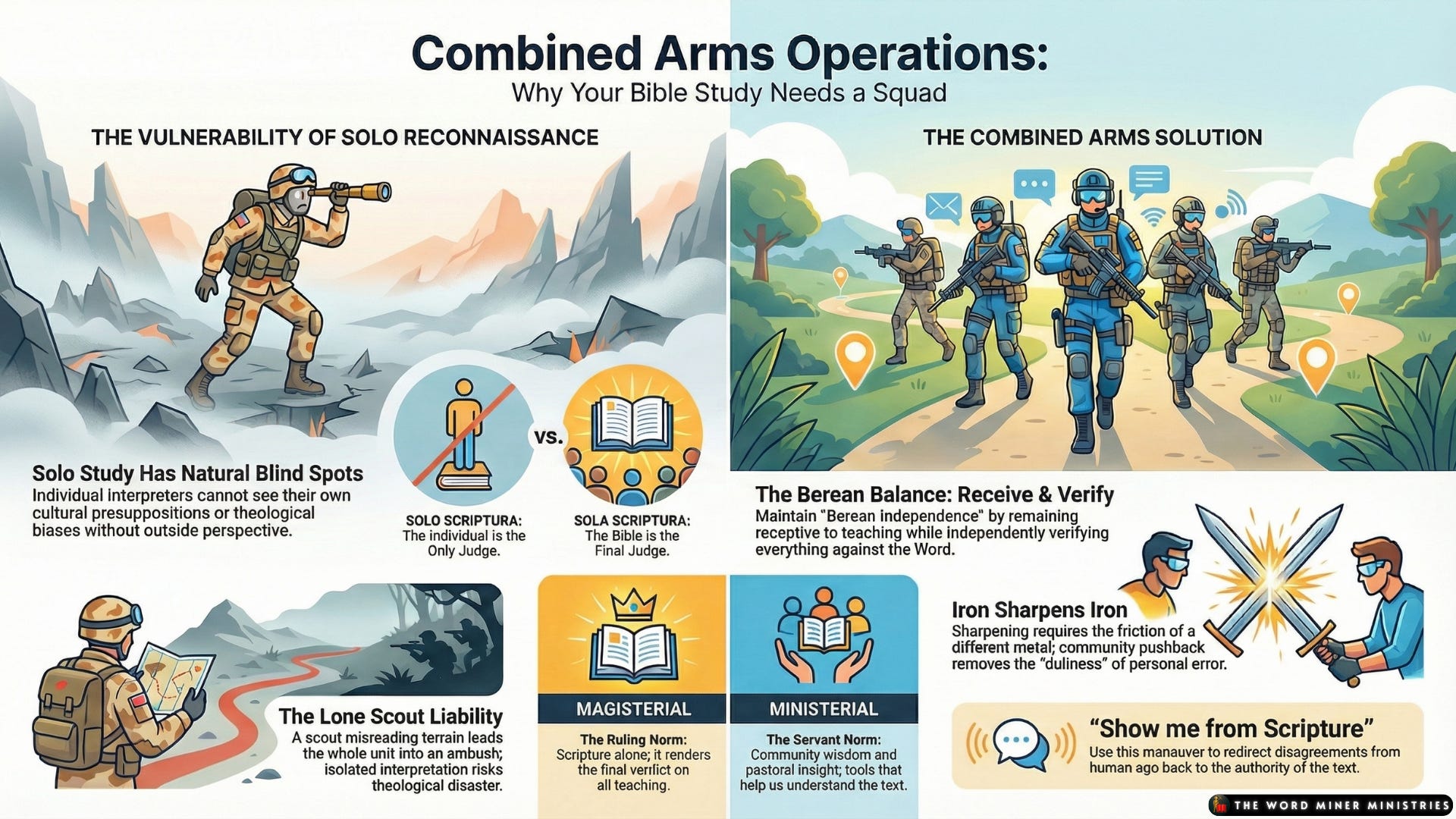
In any serious military operation, a lone scout sent ahead of the main force is genuinely valuable. A skilled reconnaissance soldier gathers critical intelligence: terrain features, enemy positioning, potential threat vectors, route viability. That intelligence is real and it matters. No commander dismisses a scout’s report because it came from one person.
But here is what no field commander ever forgets: that lone scout, for all his skill, is also the most vulnerable asset on the battlefield. He has no firepower to sustain a contact. He has limited visibility — what he sees from his position is real, but it is not the whole picture. He cannot cover his own blind spots. And if he gets it wrong — if he misreads the terrain, if he mistakes a prepared ambush for a clear route — the entire unit follows his intelligence into disaster.
Wars are not won by lone scouts.
Wars are won through combined arms operations — the synchronized deployment of infantry, armor, and air support working in coordinated harmony. In a combined arms formation, each element covers the blind spots and vulnerabilities of the others. The armor protects the infantry in open terrain. The infantry clears the close terrain the armor cannot navigate. The air support sees the battlefield from an angle neither ground element can access. No single asset wins the fight alone. The victory comes from the integration of complementary strengths operating under a unified command.
Now apply that picture to biblical interpretation. Apply it carefully, because the implications are immediate and personal.
Every Truth Prospector who has done the hard work of systematic, personal Bible study has conducted genuine reconnaissance. You sat down with your concordance. You traced the cross-references. You refused to accept the first surface-level answer the text seemed to offer. You dug. That work is real, and it matters.
But here is what the materials must establish plainly: your solo reconnaissance, however skilled, carries the vulnerabilities of every lone scout. You cannot fully see your own blind spots — by definition, they are the things you cannot see. You cannot entirely escape the cultural, experiential, and theological presuppositions you carry into the text, because no one reads the Bible from a completely neutral vantage point. Your personal interpretive history — the traditions you were raised in, the church you attended, the sermons that shaped your early understanding of Scripture — all of it shapes the lens through which you read, whether you intend it to or not.
This is not a criticism. It is a diagnosis. And the treatment is not to abandon personal study. The treatment is to integrate your personal study into the combined arms of the Body of Christ.
The Theory: Sola Scriptura Does Not Mean Solo Scriptura
Before we press any further into the practical implications, we need to deal with a theological misunderstanding that many sincere Truth Prospectors have inherited — one that sounds like conviction but functions like isolation.
The great battle cry of the Protestant Reformation was Sola Scriptura — by Scripture alone. It was a declaration of magnificent courage against an ecclesial system that had placed human tradition, papal decree, and conciliar authority on equal or superior footing with the Word of God. The Reformers were right. The Bible alone stands as the supreme, infallible, uniquely normative authority over all Christian doctrine and practice. Every tradition, every teaching, every teacher — including the most gifted and the most experienced — must be tested against, and ultimately submitted to, the plain teaching of Scripture. That principle is non-negotiable, and nothing in this essay revises it even slightly.
But here is the critical distinction that many sincere students have never been taught:
Sola Scriptura and Solo Scriptura are not the same thing. They are not even close.
Solo Scriptura — the belief that a Christian should interpret the Bible entirely in private, completely divorced from the community of faith, historical insight, pastoral guidance, or the collective wisdom of mature believers — is not a courageous application of the Reformation principle. It is an error. A subtle one, but a serious one. Because Solo Scriptura operates on the illusion of absolute independence that does not, in fact, exist.
Here is the precise distinction worth holding: Sola Scriptura affirms that the Bible is the final judge over all other sources of knowledge. It does not claim that the Bible is the only source that God uses to help His people understand truth. The collective wisdom of the believing community, the insights of mature brothers and sisters who have spent decades in the Word, the tested understanding of those who have already walked the terrain you are now navigating — these are not competitors to Scripture’s authority. They are ministerial tools that serve the student’s engagement with Scripture, always subject to it, never replacing it.
The technical language for this distinction is helpful. Magisterial authority belongs to Scripture alone — it is the norma normans, the ruling norm, the final judge of all human teaching and tradition. Everything else — reason, experience, the insights of the community, the counsel of teachers — possesses only ministerial authority. These are norma normata — ruled norms, servant norms, tools that help us understand the supreme text without ever displacing it.
The practical implication is liberating rather than threatening. You are not abandoning Sola Scriptura when you bring your interpretation to a mature believer and ask them what Scripture they see. You are practicing it. You are subjecting both your interpretation and theirs to the authority of the text — which is exactly what the Bible models for us.
The Three Texts That Build the Mandate
Three specific Scripture passages construct the biblical mandate for what we are calling Combined Arms Operations. Each one addresses a different dimension of the relationship between individual study and corporate engagement.
Acts 17:11 — The Berean Balance
The believers in Berea have given every serious student of Scripture one of the most important models in the New Testament. Luke records it this way: “These were more noble than those in Thessalonica, in that they received the word with all readiness of mind, and searched the Scriptures daily, whether those things were so” (Acts 17:11, NKJV).
Read that carefully. Notice both sides of the equation, because both are essential.
The Bereans received the word with all readiness of mind. They were not skeptics. They were not defensive, suspicious, or closed. They came to Paul’s teaching with genuine openness and intellectual engagement. They were willing to be taught. This was not weakness or intellectual cowardice — it was the disciplined humility of students who understood that they did not already know everything and that God might be speaking through a teacher they had not yet heard.
And simultaneously — on the very same day, from the very same session — those same Bereans searched the Scriptures daily to see whether those things were so. They did not accept Paul’s teaching because of his apostolic credentials, his rhetorical brilliance, or his obvious theological depth. They opened the text and verified. Every claim was tested against Scripture. Every interpretive connection was traced independently. Paul himself was subjected to the supreme authority of the Word he claimed to be teaching.
This is the model. Receptive enough to genuinely receive instruction from the community. Independent enough to verify every word of that instruction against Scripture itself. Not one or the other. Both. Simultaneously. In permanent, dynamic tension.
The phrase that captures this balance is “Berean independence” — and it is not the independence of the lone scout. It is the independence of the soldier who knows how to operate their own weapon with complete proficiency, while remaining fully integrated into the unit and committed to the unit’s collective mission. You verify everything yourself. And you bring your verified findings to the community for further testing.
Proverbs 27:17 — The Friction of Fellowship
Solomon delivers one of the most practically precise statements in the wisdom literature: “Iron sharpeneth iron; so a man sharpeneth the countenance of his friend” (Proverbs 27:17, NKJV).
The physics of this image are worth pressing. Iron does not sharpen itself. You cannot take a blade and rub it against its own edge to produce a keener point. The sharpening requires a different piece of metal — a whetstone, a file, another blade — whose hardness creates the friction that removes the dull material and reveals the sharp edge beneath.
In interpretation, the friction is not the enemy. The friction is the process.
When a mature believer examines your cross-reference chain and says, “I see what you are tracing, but what about this passage over here?” — that is friction. When someone whose theology differs from yours asks a question you have not considered — that is friction. When the community pushes back on a connection you made between two passages and asks you to show more evidence — that is friction.
And that friction is doing for your theology precisely what the whetstone does for the blade.
Every Truth Prospector has experienced the opposite of this — the isolation that comes from studying exclusively alone, convinced that the conclusions reached in private study need no further refinement. The materials are plain about what happens in that environment: the isolated interpreter becomes susceptible to theological fads, to mistaking personal imagination for divine illumination, to seizing upon a novel interpretation and making it an all-absorbing theme that ultimately distorts rather than clarifies. These errors do not feel like errors from the inside. That is precisely what makes them dangerous. The lone scout does not know he has misread the terrain until the ambush is already sprung.
The community’s friction prevents the ambush. Not by replacing your study. By sharpening it.
Hebrews 10:24-25 — The Assembly as Essential Infrastructure
The writer of Hebrews adds the third and most urgent dimension of this mandate: “And let us consider one another to provoke unto love and to good works: Not forsaking the assembling of ourselves together, as the manner of some is; but exhorting one another: and so much the more, as ye see the day approaching” (Hebrews 10:24-25, NKJV).
The word translated “consider” here is the Greek katanoeo — a word that carries the sense of concentrated, careful, deliberate attention. It is not a casual glance at a fellow believer. It is the kind of focused observation that a skilled operator gives to a situation they are responsible for navigating correctly. The writer of Hebrews is commanding believers to study one another — to pay sustained, thoughtful attention to the spiritual condition and growth of those in the assembly — and to use that attention as the basis for provocation to love and to good works.
The assembly, in other words, is not a passive gathering of individuals sitting in rows. It is the operational environment in which the theology developed in individual study becomes active in community life. You do not study in isolation and then attend an assembly that has nothing to do with what you found. You bring what you found to the assembly, and the assembly tests it, applies it, and incorporates it into the life of the body.
And the eschatological urgency of this command cannot be overlooked. The writer does not say “assemble as time permits.” He says “so much the more, as you see the day approaching.” As the prophetic timeline advances — as the sanctuary’s most holy phase moves toward its consummation — the assembly becomes more critical, not less. The body of believers assembled around the Scripture-alone methodology is the defensive perimeter against the deceptions that intensify as the end approaches. No lone scout can hold that perimeter alone.
Skill Development: Giving and Receiving Correction with Grace
Understanding the theology of Combined Arms Operations is necessary. But the theology becomes operational only when it produces a specific, difficult, deeply personal skill: the ability to give and receive biblical correction with grace while maintaining Berean independence.
Let’s be frank about why this is hard.
Receiving correction requires that you acknowledge you might be wrong. For a Truth Prospector who has invested significant time, intellectual energy, and spiritual attention into a specific interpretation, “you might be wrong” lands with the weight of personal failure rather than academic adjustment. Pride — the ego’s need to be right — is the most powerful jamming signal in corporate Bible study, and it operates with extraordinary subtlety. It does not announce itself as pride. It announces itself as conviction. It disguises itself as principled certainty. It wraps itself in the language of Sola Scriptura while functionally practicing Solo Scriptura — protecting a cherished interpretation from external scrutiny under the banner of independence.
The test of a genuinely teachable spirit is not whether you are willing to receive correction when you know you are wrong. Any honest person can do that. The test is whether you are willing to submit your interpretation to scrutiny when you are convinced you are right — and to remain genuinely open to the possibility that the community sees something in the text that your solo reconnaissance missed.
This requires humility as a theological posture, not merely a personality trait. And it produces a specific practical protocol for engaging disagreement.
When a mature believer challenges an interpretation you have built from personal study, the materials establish a clear rule: do not argue. Not because argument is inherently wrong, but because argument in this context almost always devolves from a textual question into a contest of human egos. The moment you shift from “let’s examine the passages together” to “let me explain why my reading is better than yours,” you have abandoned the field of biblical exegesis and entered the field of debate — and in that field, the winner is determined by rhetoric, not by the text.
The counter-maneuver is simple, disarming, and extraordinarily effective: “Show me from Scripture.”
Not “prove it to me.” Not “I disagree.” Simply: “Show me from Scripture why you see it that way.” That single response accomplishes three things simultaneously. It redirects the conversation from human opinion back to textual evidence. It demonstrates genuine openness to the correction rather than defensive rejection of it. And it forces the correcting party to ground their position in the Word rather than in tradition, personal preference, or the authority of a teacher they respect.
If the correction can be demonstrated from a plain scriptural text — if the mature believer can open the Bible and show you passages that genuinely challenge the connection you built — then Berean independence demands that you receive it. You adjust your interpretation. Not because of who said it. Because of what the Scripture shows.
If the correction cannot be demonstrated from a plain scriptural text — if the pushback is grounded in denominational tradition, personal discomfort, or the argument that your conclusion is unconventional — then Berean independence demands that you maintain your position and ask the text to be the judge.
In both cases, the Bible remains the final commander. That is Sola Scriptura functioning exactly as designed.
Live Fire Exercise: Taking Revelation 13 to the Squad
Every training cycle must eventually move from the classroom to the field. This is where Combined Arms Operations stops being a concept and becomes a practice.
The assignment is specific. Take the interpretation you built during Week 4 — the cross-reference chain that decoded the symbolism of the beast of Revelation 13 by letting Scripture define its own symbols — and present it to a mature believer. Not to impress them. Not to recruit them. To test your findings.
The procedure matters as much as the content. Present your biblical evidence — the specific chain of references, the passages that established each symbol’s meaning from within the text itself — and then do something that may feel counterintuitive for any Truth Prospector who has done serious solo work: stop talking and listen. Actively, genuinely listen to the mature believer’s response. Compare their scriptural evidence with yours. If they see the connections differently, ask them to walk you through their cross-reference chain. Where does their chain begin? Which passages anchor their understanding? How does their reading of Revelation 13 integrate with the sanctuary imagery that runs through both Daniel and the Apocalypse?
If they disagree — and they may, especially on highly symbolic prophetic territory — do not argue. Do not defend your cross-reference work by asserting how many hours it required. Ask them to show you from Scripture why. And mean it. Approach their answer with the same hermeneutical rigor you applied to your own study — neither dismissing their position because it differs from yours nor accepting it simply because they are more experienced. Trace their references. Test their connections. Let the text be the judge of both interpretations simultaneously.
The goal of this exercise is not to arrive at a conclusion that both parties find comfortable. The goal is to arrive at the interpretation that the Scripture most clearly supports — regardless of which party originally held it and regardless of what tradition endorses or rejects it. The Truth Prospector who comes out of this exercise with a refined, sharpened, cross-reference-verified understanding of Revelation 13 — whether that understanding confirms or corrects their original position — has executed the Combined Arms protocol exactly as designed.
Application: Forming the Squad
The live fire exercise is a single engagement. But Combined Arms Operations is not a single engagement. It is a posture — a permanent integration of individual study into corporate accountability that must be sustained over time to produce the kind of theological precision that the materials have been building toward from the beginning.
The application, then, is this: join or form a small Bible study group committed strictly to the Scripture-alone methodology.
Not a group that discusses what various teachers and commentators believe. Not a group organized around a particular denominational curriculum. A group where every participant brings their personal study — their concordance work, their cross-reference chains, their questions from the text — and where the group’s shared commitment is to let Scripture interpret Scripture, together, without importing external authorities to resolve the questions the text itself raises.
That group becomes your combined arms unit. And what it produces in each member is the integration that no amount of solo study can achieve: the iron-sharpens-iron friction that exposes blind spots, the Berean accountability that keeps every interpretation anchored to the text, and the community stability that prevents the isolation error from taking root.
The Body of Christ, functioning in exactly this way, is not a social support structure for believers who find Scripture study lonely. It is an operational necessity for believers who intend to understand Scripture accurately. Paul could not have said it more plainly than he did to the church at Corinth: “For as the body is one and has many members, but all the members of that one body, being many, are one body, so also is Christ” (1 Corinthians 12:12, NKJV). The diversity of the body — different backgrounds, different study histories, different angles of approach to the same text — is not a problem to be managed. It is the architecture of the combined arms formation. Each member covers the blind spots the others carry. Together, the unit sees what no single soldier can see alone.
The Balance That Scripture Demands
Let me close by naming the tension this essay has been holding throughout — because Truth Prospectors need to hold it too, rather than collapsing into one side or the other.
The individual believer is fully responsible before God for their personal engagement with Scripture. No community, no pastor, no council of mature believers, no denominational authority can stand between the believer and the text, interpreting it for them as a magisterial arbiter whose conclusions require blind submission. The Bereans verified Paul. You are permitted — required — to verify every teacher, including the most gifted ones you will ever encounter. The Reformation’s great principle stands unchanged and unbending.
And simultaneously — and with equal force — the individual believer is fully dependent on the community of faith for the checks, corrections, and perspective that solo study cannot provide. The lone scout’s intelligence is valuable and real. And the lone scout, operating without his unit, will eventually get ambushed by the blind spots he cannot see from his position.
These two truths are not in conflict. They are in covenant.
“These were more noble than those in Thessalonica, in that they received the word with all readiness of mind, and searched the Scriptures daily, whether those things were so” (Acts 17:11, NKJV).
Receive with readiness. Verify with rigor. Hold them together.
That is not a compromise of Sola Scriptura. That is Sola Scriptura operating exactly as God designed it — in the community He built to carry it, refine it, protect it, and pass it on to the generation that comes after.
Find your squad, Truth Prospector. Bring your best work. Let the iron do its work on you. And let the Word of God — always the Word of God — be the final judge of everything you find together.
Scripture References Used in This Essay: Acts 17:11 | Proverbs 27:17 | Hebrews 10:24-25 | 1 Corinthians 12:12 | Ephesians 4:11
All Scripture quotations taken from the New King James Version (NKJV) © 1982 Thomas Nelson, Inc. or the New American Standard Bible 1995 Edition (NASB95) © The Lockman Foundation.
All interpretations presented are subject to Scripture itself as the ultimate authority. Readers are encouraged to verify all teaching through personal Bible study following the Berean example (Acts 17:11).
The Word Miner Ministries | thewordminer.org

Ready for Biblical Study That Goes Deeper Than Sunday School?
Join Truth Prospectors receiving systematic biblical teaching using Scripture-interpreting-Scripture methodology. No denominational filters. No shallow devotionals. Just the authority of God’s Word unlocking Christ’s complete ministry through the Sanctuary framework.
The Word Miner Ministries Resource
LISTEN to The Word Miner Podcast
Tired of surface-level Bible teaching? Join us as we tactically mine Scripture’s hidden treasures through sanctuary-based interpretation. Discover how systematic Bible study reveals Christ’s complete ministry and empowers you to unearth profound truths that denominational traditions often miss.

Your spiritual expedition begins now.
READ Our Daily Devotional: The Daily Shekinah Revival
Daily devotions restoring God’s glory within. A biblical devotional series that guides Truth Prospectors through daily encounters with God’s presence, using sanctuary typology and Scripture-centered teaching to restore authentic spiritual revival in the believer’s heart and life.

Read our daily devotional today!
GET The Book: THE WAY: Discovering God’s Blueprint

What if the Bible’s greatest interpretive key has been hiding in plain sight—and once you see it, Scripture will never look scattered again?
The Biblical Sanctuary: God’s own architectural blueprint embedded in Scripture from Genesis to Revelation is not a human system imposed on the text, but a divinely designed pattern that unlocks prophecy, reveals Christ’s ministry, and transforms fragmented knowledge into systematic understanding.
Connect With Us:
Find Us on Social Media:
Legal “Stuff”
© 2026 The Word Miner Ministries