

Listen to Audio “Deep Dive” Discussion.
Download The Discussion “Slide Deck.”

I learned something critical about weapons during my first field training exercise at Fort Jackson, South Carolina.
They handed me my rifle. Standard issue M16A2. I’d been through basic rifle marksmanship, qualified on the range, memorized all the specifications. I thought I knew my weapon.
Then we hit the field, and everything changed.
Mud. Rain. Darkness. Malfunctions I’d never trained for. And suddenly, all that classroom knowledge meant nothing if I couldn’t actually operate the weapon under pressure. I had to know it intimately—not just theoretically, but practically. Load it. Clear it. Maintain it. Trust it with my life.
Here’s what bothers me about the state of Christianity today.
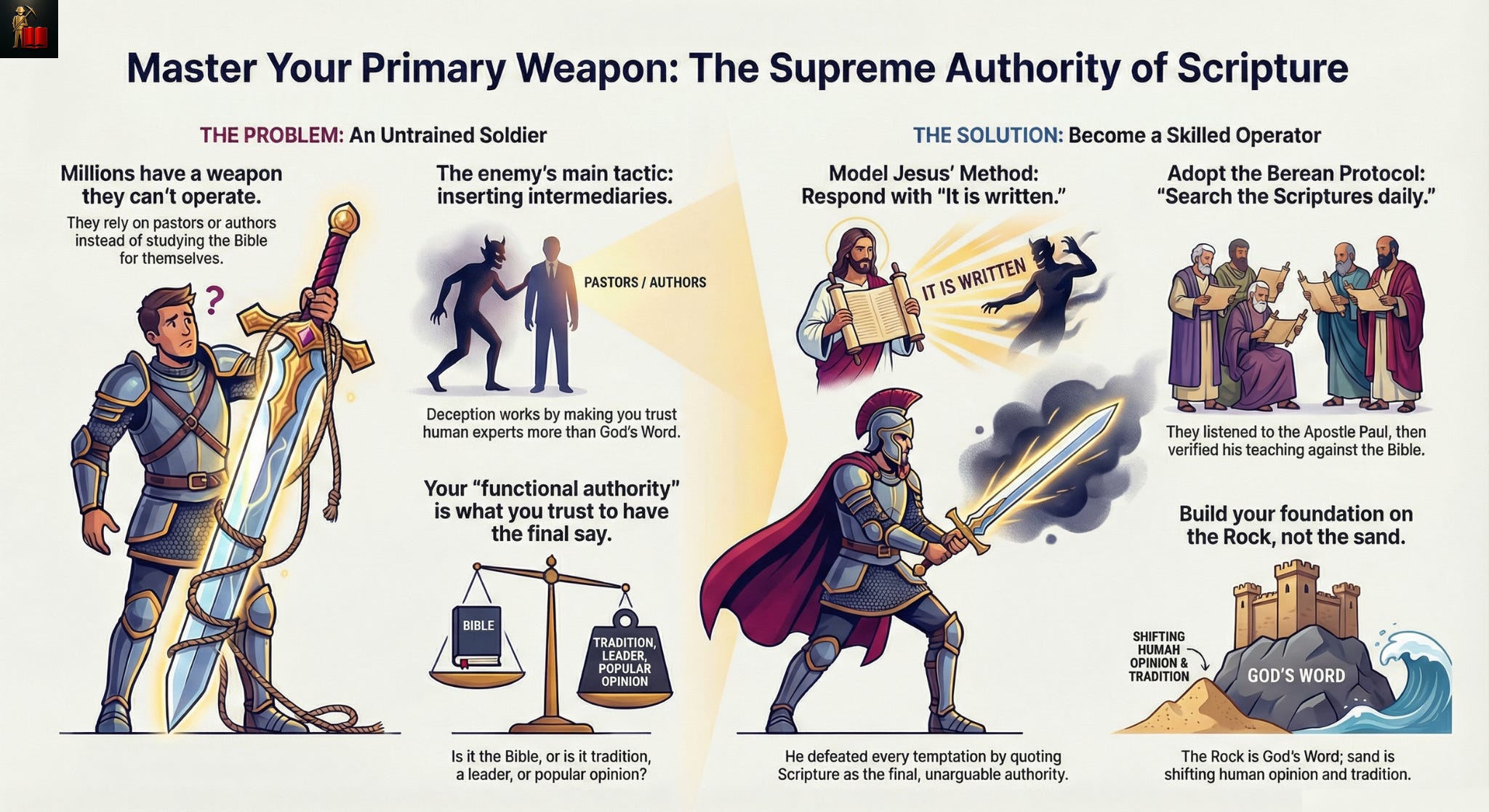
Millions of believers have been handed the Bible—the very Word of God—but they’ve never learned to operate it for themselves. They wait for Sunday sermons to tell them what it says. They depend on popular authors to explain what it means. They defer to denominational authorities to settle what they should believe.
They’ve never qualified on their primary weapon.
And when the enemy attacks with twisted theology, with half-truths wrapped in Bible verses, with appeals to tradition that contradict Scripture—they have no defense. They don’t know the weapon well enough to use it effectively.
The first foundational pillar of biblical study is this: Scripture alone is the supreme authority. Not Scripture plus tradition. Not Scripture plus church councils. Not Scripture plus popular opinion.
Scripture. Alone.
This isn’t just theological theory for academic debate. This is your survival protocol in the cosmic conflict between truth and error.
What Makes Something an Authority?
Let me ask you something.
When you need to know what the Bible teaches about death, or hell, or Christ’s ministry after the cross—where do you go first?
Be honest.
Do you open your Bible and start investigating? Or do you consult your favorite commentary? Call your pastor? Google it and see what the top results say?
I’m not condemning any of those resources. But here’s the question that matters: What has the final say?
Because whatever has the final say—whatever you trust to settle the question when sources disagree—that’s your functional authority. Not your theoretical authority. Your actual, operational, this-is-what-I-rely-on authority.
The Apostle Paul was clear about where that authority belongs:
All Scripture is given by inspiration of God, and is profitable for doctrine, for reproof, for correction, for instruction in righteousness, that the man of God may be complete, thoroughly equipped for every good work. (2 Timothy 3:16-17)
Notice what Paul says Scripture does. It equips you thoroughly for every good work. Not partially. Not incompletely. Thoroughly. For every good work.
That means Scripture is sufficient. It’s complete. It’s adequate for everything God intends you to know and do.
If something else needs to supplement Scripture to make it complete, then Scripture isn’t actually sufficient, is it? If church tradition needs to “fill in the gaps,” then the Bible has gaps. If the Pope or a church council needs to authoritatively interpret what Scripture “really means,” then the Bible isn’t actually your final authority—the interpreter is.
The interpreter always trumps the text.
Think about it. If I hand you a document and say, “This is authoritative, but you need me to tell you what it means, and my interpretation is binding”—who actually has the authority? The document, or me?
Jesus confronted this exact problem with the religious leaders of His day:
All too well you reject the commandment of God, that you may keep your tradition... making the word of God of no effect through your tradition which you have handed down. (Mark 7:9, 13)
They had elevated human traditions to the point where those traditions actually nullified Scripture’s authority. When Scripture said one thing and tradition said another, they chose tradition.
And they thought they were being faithful.
Your Primary Weapon System
Let me give you a military framework for understanding this.
In any combat operation, you have a primary weapon system. For infantry, that’s typically your rifle. You have secondary weapons—sidearm, grenades, knife—but the rifle is primary. It’s what you rely on. It’s what you train with constantly. It’s what you maintain meticulously.
Scripture is your primary weapon in spiritual warfare.
But here’s what that means practically. You can’t just know your weapon exists. You can’t just carry it around and feel good about having it. You have to learn to operate it.
What does that look like with the Bible?
It means learning to use a concordance to track concepts across Scripture. It means developing skill in cross-referencing passages to see how the Bible interprets itself. It means building the competence to investigate truth personally before consulting outside sources.
Think of it as basic training for Bible study.
In military basic training, you learn your weapon system from the ground up. You learn to load, fire, clear malfunctions, clean, maintain, and troubleshoot. You do it so many times that it becomes instinctive. When you’re under pressure, you don’t have to think—you operate.
That’s what needs to happen with Scripture.
You need to get to the point where someone makes a claim—”The Bible says this about that”—and your instinct is to verify it yourself. Not to accept it because the person seems credible. Not to assume they’ve done their homework. But to open your Bible and check.
The Bereans understood this. When Paul showed up in their city and started teaching, they didn’t just accept his words because he was Paul. Look at what they did:
These were more fair-minded than those in Thessalonica, in that they received the word with all readiness, and searched the Scriptures daily to find out whether these things were so. (Acts 17:11)
They searched the Scriptures daily.
Not once. Not when convenient. Daily. They were testing apostolic teaching against Scripture. If the Bereans tested Paul—a genuine apostle who wrote half the New Testament—how much more should you test modern preachers, authors, and denominational statements?
Here’s the test: Does this teaching align with what Scripture actually says, or am I accepting it based on who’s saying it?
The Enemy’s Primary Tactic
Satan has been using the same tactic since Eden.
He doesn’t usually attack Scripture directly. He’s too smart for that. Instead, he inserts intermediaries between you and God’s Word. He gets you to rely on someone else’s interpretation rather than investigating for yourself.
Why is this so effective?
Because it feels humble. It feels wise. “Who am I to interpret Scripture? I’m not a scholar. I don’t have a theology degree. I should just trust the experts.”
Sounds reasonable, right?
But look at what it actually does. It transfers your dependence from Scripture to human authority. It places your eternal interests in the hands of someone else’s understanding—someone who might be sincere but wrong, or might have institutional biases, or might be subordinating Scripture to tradition without even realizing it.
The prophet Isaiah gave us the test:
To the law and to the testimony! If they do not speak according to this word, it is because there is no light in them. (Isaiah 8:20)
Every teaching has to be brought to Scripture for validation. Every. Single. One.
No matter who’s teaching. No matter how many people believe it. No matter how long it’s been tradition. No matter how unpopular it would be to question it.
Scripture is the detector of error.
You want to know if something is true? Measure it against God’s Word. You want to expose deception? Turn on the light of Scripture. You want to protect yourself from false teaching? Learn to operate your primary weapon.
That’s not arrogance. That’s basic spiritual self-defense.
Two Kinds of Authority: Rulers and Servants
Here’s a distinction that will save you from a lot of confusion.
There are two kinds of authority: ruling authority and serving authority.
Scripture has ruling authority. It commands. It governs. It judges. When Scripture speaks, the matter is settled. Other sources serve Scripture—they don’t rule over it.
Think about it this way. In a military unit, the commanding officer has ruling authority. The chaplain has serving authority. The chaplain offers counsel, encouragement, spiritual guidance. That counsel can be incredibly valuable. But the chaplain doesn’t command the mission. He serves those who do.
Similarly, commentaries, Bible teachers, church traditions, even genuine prophetic gifts—they can all serve your understanding of Scripture. They can illuminate. They can provide helpful context. They can point out connections you might have missed.
But they don’t command Scripture. They don’t complete it. They don’t have the authority to overrule it or interpret it in ways that contradict what it plainly says.
When conflict arises—when tradition says one thing and Scripture says another, when your pastor’s interpretation doesn’t match what the text actually says, when popular teaching contradicts biblical testimony—Scripture wins. Every time.
No exceptions.
Let me ask you: What happens in your church if someone discovers that a cherished tradition contradicts Scripture? What happens if biblical investigation leads to conclusions that differ from denominational positions?
Your answer to that question reveals where authority actually resides in that system.
How Jesus Operated His Primary Weapon
Want to see this principle in action? Watch how Jesus used Scripture.
The wilderness temptation is the master class.
Jesus had just been baptized. The Spirit had descended on Him. The Father had declared, “This is My beloved Son, in whom I am well pleased.” Then immediately—immediately—the Spirit led Him into the wilderness to be tempted by the devil.
Forty days of fasting. Weakened physically. Vulnerable humanly. And Satan showed up with his most sophisticated attacks.
First temptation: appetite. “If You are the Son of God, command that these stones become bread.” Sounds reasonable, right? Jesus was hungry. He had the power. Why not?
Jesus responded:
It is written, ‘Man shall not live by bread alone, but by every word that proceeds from the mouth of God.’ (Matthew 4:4)
Notice what He didn’t do. He didn’t argue. He didn’t debate the merits. He didn’t explain His reasoning. He quoted Scripture and let it speak.
Second temptation: presumption. Satan took Him to the pinnacle of the temple and said, “If You are the Son of God, throw Yourself down”—and then Satan quoted Scripture. Psalm 91. About angels protecting God’s people.
Jesus responded:
It is written again, ‘You shall not tempt the LORD your God.’ (Matthew 4:7)
Third temptation: compromise. Satan offered Him all the kingdoms of the world if He would worship him. Just one act of worship—bypass the cross, avoid the suffering, get the kingdoms now.
Jesus responded:
Away with you, Satan! For it is written, ‘You shall worship the LORD your God, and Him only you shall serve.’ (Matthew 4:10)
Three temptations. Three responses. All Scripture.
Here’s what staggers me about this. Jesus, Messiah, the Son of God. He possessed all wisdom. He could have explained truth from His perfect knowledge. He could have appealed to His own divine authority.
But He didn’t.
He placed Himself under the authority of the Written Word. Not to supplement it with His own ideas. Not to clarify what it “really meant.” He quoted Scripture and trusted its authority to settle the matter.
Why?
To demonstrate that the Bible is the ultimate standard for everyone—including the Son of God during His earthly ministry. If the Creator submitted to Scripture’s authority, what makes you think you don’t have to?
When the Enemy Quotes Scripture
Here’s the tactical detail that keeps me up at night.
Satan quoted Scripture in the wilderness. He took Jesus to the temple pinnacle and cited Psalm 91: “He shall give His angels charge over you” and “In their hands they shall bear you up, lest you dash your foot against a stone.”
The devil knows the Bible.
He knows it better than most Christians. He can quote it fluently. He can cite chapter and verse. He can make it sound authoritative and convincing.
So merely quoting Bible verses isn’t enough to defend yourself. You have to know the correct meaning and context to resist deception.
How did Jesus detect Satan’s misuse?
Because He knew the exact words of Scripture and the context in which they appear. Satan had carefully edited Psalm 91, removing “to keep you in all your ways”—the part that qualifies the promise. The promise of angelic protection applies to those walking in God’s ways, not those presuming on God through reckless testing.
Context matters. Accuracy matters. Knowing the Word deeply matters.
This is why surface-level Bible knowledge leaves you vulnerable. Satan can twist Scripture if you don’t know it well enough to recognize the distortion. He can quote half a verse and make it sound like the whole truth. He can lift words out of context and make them say whatever he wants.
Your only defense is to know your primary weapon better than the enemy does.
How do you do that?
You read it. You study it. You cross-reference it. You trace concepts through the entire canon. You let Scripture interpret Scripture. You build comprehensive understanding rather than collecting favorite verses.
You qualify on your weapon.
What Scripture Alone Actually Means
Let’s get specific about what we’re affirming and what we’re denying when we say “Scripture alone is the supreme authority.”
What We Affirm
Scripture is sufficient. It contains everything necessary for salvation and godly living. Nothing essential is missing.
Paul told Timothy:
...from childhood you have known the Holy Scriptures, which are able to make you wise for salvation through faith which is in Christ Jesus. (2 Timothy 3:15)
The Scriptures are able—they possess the power and adequacy to accomplish their purpose. You don’t need additional revelation to complete what God has said.
Peter confirms this:
His divine power has given to us all things that pertain to life and godliness, through the knowledge of Him. (2 Peter 1:3)
All things. Not most things. Not the basic things. All things necessary for life and godliness have been provided through the knowledge of Christ as revealed in Scripture.
Scripture is unified. Because the Holy Spirit is the ultimate Author, the Bible possesses internal harmony. One part explains another. Old Testament and New Testament work together. Every book contributes to the complete picture.
David understood this:
The entirety of Your word is truth, and every one of Your righteous judgments endures forever. (Psalm 119:160)
The entirety—not fragments, not isolated verses, but the whole counsel of God working together as one revelation.
What does this mean practically? It means you can’t build sound doctrine on a single verse. You have to gather everything Scripture says about a subject. When you do, you’ll find the passages fit together perfectly—every truth developing from another, every prophecy explaining another.
Scripture interprets Scripture. The Bible provides its own principles for understanding itself. Clear passages illuminate difficult ones. The obscure bows to the clear. You use the whole testimony of Scripture to understand individual parts.
Isaiah described the method:
For precept must be upon precept, precept upon precept, line upon line, line upon line, here a little, there a little. (Isaiah 28:10)
You build understanding systematically. You let the Bible define its own terms. You trace concepts across the canon until the full picture emerges.
What We Deny
We’re not isolationists. Scripture alone doesn’t mean Scripture only—as if you should never read anything else or learn from other believers.
We read the Bible in community. We benefit from teachers. We study church history. We use concordances, commentaries, and study helps.
But we test everything. The Bereans “received the word with all readiness, and searched the Scriptures daily to find out whether these things were so” (Acts 17:11). They listened to Paul—then they verified what he said against Scripture.
That’s the pattern. Learn from others. But verify everything.
Scripture isn’t the only source of all knowledge. The Bible doesn’t teach you mathematics or engineering or how to cook. You learn countless true things through observation, experience, and study of the natural world.
“The heavens declare the glory of God; and the firmament shows His handiwork” (Psalm 19:1). Creation reveals God’s power and character.
But when conflicts arise between human reasoning and biblical revelation, Scripture judges. Why? Because sin has corrupted human faculties. “The heart is deceitful above all things, and desperately wicked; who can know it?” (Jeremiah 17:9). We need the corrective lens of Scripture to see clearly.
No human authority has final interpretive power. This is where Scripture alone confronts institutional religion most sharply.
No religious leader possesses infallible interpretation. No denomination owns the truth. No council can declare, “The matter is settled—you must believe our interpretation.”
Why? Because accepting such an authority transfers final power from Scripture to the human interpreter. Whatever that interpreter says Scripture means becomes more authoritative than what Scripture actually says.
Jesus condemned this: “All too well you reject the commandment of God, that you may keep your tradition” (Mark 7:9). When tradition overrides Scripture, you’ve functionally rejected God’s authority.
How to Actually Use This Weapon
Theory is great. But how do you actually implement this? How do you make Scripture your functional authority rather than just your theoretical one?
Step 1: Establish Your Verification Protocol
Pick a theological question. Something you believe. Something your church teaches.
Now here’s the exercise: Prove it from Scripture alone.
Not from your pastor’s sermon. Not from your favorite author. Not from denominational statements. Just the Bible.
Open your concordance. Find every passage that addresses the topic. Write them down. Study them in context. See what patterns emerge. Build your understanding from biblical evidence.
Try these:
What happens after you die?
What is Hell?
What is Christ doing in heaven right now?
How is a person saved?
What role does God’s law play in the Christian life?
For each question, build your answer exclusively from Scripture. Then—only then—consult other sources to see if they align with what the Bible actually says.
You might be surprised by what you find.
Step 2: Demand Biblical Proof for Everything
When someone teaches something—anyone, including me—ask for biblical evidence.
Don’t ask, “Is this person credible?” Ask, “Is this biblical?”
Don’t accept teaching based on credentials, popularity, or tradition. Demand chapter and verse. Examine the context. Verify the interpretation.
If someone says, “The church has always taught this,” respond with, “Show me where Scripture teaches it.”
If they say, “All the scholars agree,” respond with, “What does the Bible say?”
If they appeal to tradition or ecclesiastical authority, respond with, “Give me a plain ‘Thus saith the Lord.’”
That’s not being difficult. That’s being Berean.
Step 3: Be Willing to Change When Scripture Demands It
This is the hard one.
What do you do when biblical investigation leads to conclusions that differ from what you’ve always believed? What happens when Scripture challenges your denominational position? When the evidence points somewhere your tradition doesn’t go?
You have a choice.
Will you follow Scripture? Or will you protect tradition?
Jesus warned: “And in vain they worship Me, teaching as doctrines the commandments of men” (Matthew 15:9).
Worship that substitutes human commandments for God’s Word is vain—empty, worthless, rejected by God.
I’m not saying change is easy. I’m not saying you should be reckless. But I am saying this: When Scripture clearly teaches something that contradicts your tradition, Scripture must win.
Your loyalty belongs to God’s Word, not to human systems.
Step 4: Master the Text Before You Master the Commentary
Here’s a practical priority: Know what the Bible says before you worry about what people say about the Bible.
A person who has read Scripture through multiple times, who has traced concepts across the canon, who knows how to navigate the text fluently—that person is better equipped than someone with a theology degree who quotes scholars but doesn’t know Scripture itself.
Joshua received this instruction:
This Book of the Law shall not depart from your mouth, but you shall meditate in it day and night, that you may observe to do according to all that is written in it. For then you will make your way prosperous, and then you will have good success. (Joshua 1:8)
Meditate in it day and night. Not in what others say about it. In it.
Become intimately familiar with your primary weapon. Know how to load it. Know how to aim it. Know how to clear malfunctions. Know how to maintain it.
Your spiritual survival depends on it.
The Foundation You Build On
Jesus ended the Sermon on the Mount with a story you probably know:
Therefore whoever hears these sayings of Mine, and does them, I will liken him to a wise man who built his house on the rock: and the rain descended, the floods came, and the winds blew and beat on that house; and it did not fall, for it was founded on the rock. But everyone who hears these sayings of Mine, and does not do them, will be like a foolish man who built his house on the sand: and the rain descended, the floods came, and the winds blew and beat on that house; and it fell. And great was its fall. (Matthew 7:24-27)
Two builders. Two foundations. Same storm.
The rock is God’s Word—solid, immovable, eternal. The sand is human opinion, tradition, philosophy, subjective experience—shifting, unreliable, temporary.
The storm reveals which foundation you built on.
And the storm is coming. Actually, it’s already here.
False teaching multiplies. Deception intensifies. Popular Christianity drifts further from biblical truth every year. Denominations that once stood on Scripture now subordinate it to culture. Teachers who once defended the faith now deconstruct it.
In this environment, only those whose faith is anchored to Scripture will stand.
Not those who know about the Bible. Those who know the Bible. Not those who can quote scholars. Those who can quote Scripture. Not those loyal to institutions. Those loyal to truth.
Isaiah prophesied about this foundation:
Therefore thus says the Lord GOD: “Behold, I lay in Zion a stone for a foundation, a tried stone, a precious cornerstone, a sure foundation; whoever believes will not act hastily.” (Isaiah 28:16)
That foundation is Christ as revealed in Scripture. To build on Him is to build on His Word.
Your Mission Brief
Let me leave you with this.
Scripture is your primary weapon in spiritual warfare. Not your secondary weapon. Not your backup. Your primary weapon.
Everything else—commentaries, teachers, traditions, experiences—serves Scripture. They don’t rule it.
Your mission is to learn to operate this weapon so effectively that when the enemy attacks with twisted theology, with half-truths, with appeals to tradition that contradict God’s Word—you can defend yourself.
Not by arguing louder. Not by being more stubborn. But by wielding Scripture with precision and confidence.
“It is written.”
That’s how Jesus defeated Satan in the wilderness. Three words. Followed by God’s Word.
That’s your tactical methodology. That’s your defensive position. That’s your offensive capability.
Will you learn to operate your primary weapon? Will you demand biblical proof for every teaching? Will you let Scripture interpret itself rather than allowing human authorities to stand between you and God’s revealed truth?
The choice is yours.
But understand—eternity hangs in the balance.
Jesus prayed for His disciples:
Sanctify them by Your truth. Your word is truth. (John 17:17)
Truth sanctifies. Truth transforms. Truth sets you free.
And that truth is found in Scripture alone.
Now get to work. Your Bible isn’t going to study itself.
“Heaven and earth will pass away, but My words will by no means pass away.’ (Matthew 24:35)
Want to dig deeper into these truths? Explore The Core Pillars of Bible Study. Discover how Christ is the Center of all interpretation, why The Sanctuary is the Map for understanding God's Word, and learn how Scripture is the Authority that interprets itself. Join us at The Word Miner Ministries as we equip Truth Prospectors for more profound biblical discovery.

Great read brother .