

Listen to Audio “Deep Dive” Discussion.
Download The Discussion “Slide Deck.”

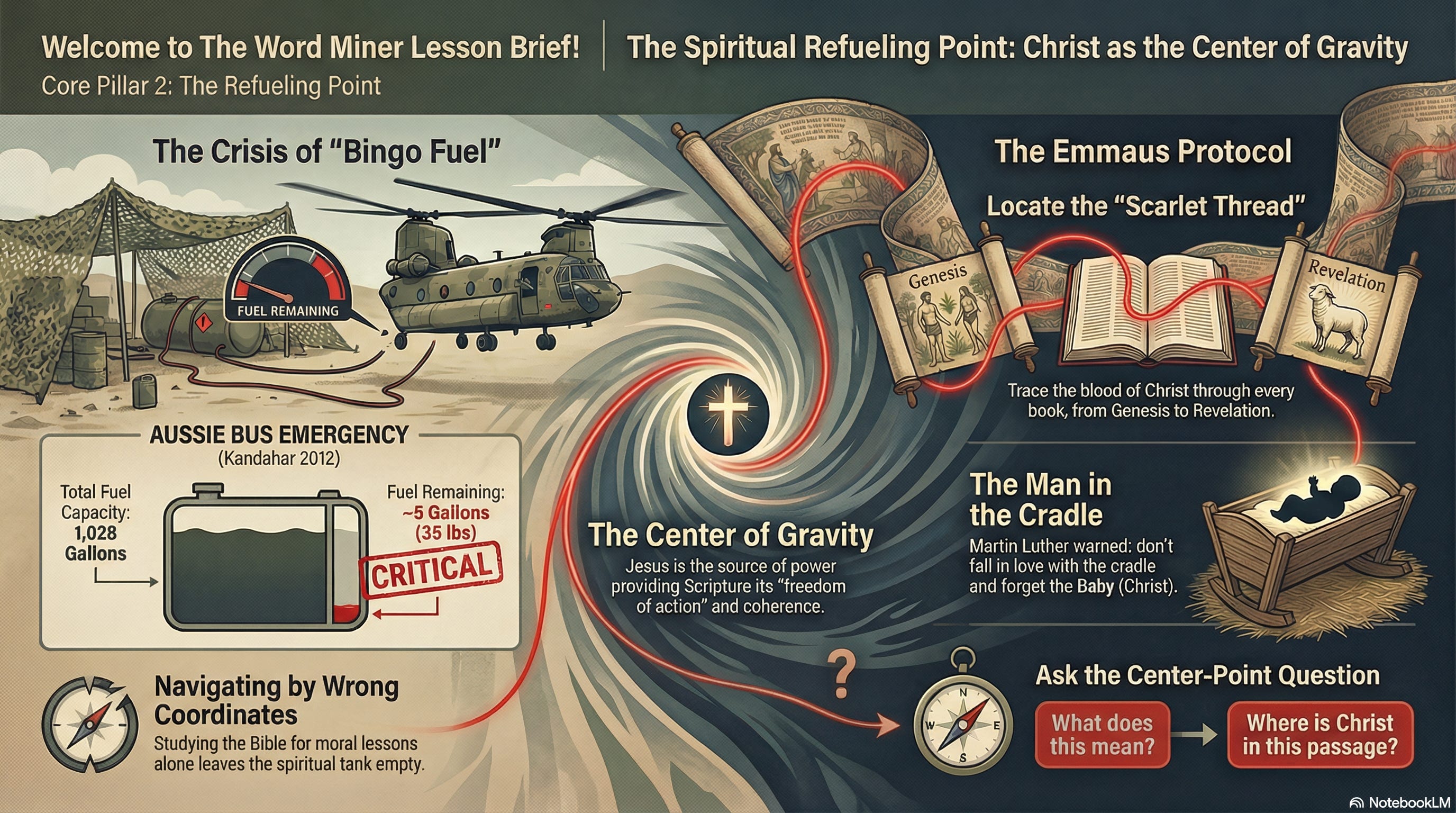
Kandahar Airfield, Afghanistan. Summer 2012. Mustang Ramp.
I was running the FARP—Forward Area Refueling Point—supporting coalition helicopter operations. Hot, dry, dusty, 120 degrees in the shade. Just another shift in the warzone.
The radio crackled. An Australian accent, tight voice: “Mustang FARP, Aussie Bus, inbound. Coming hot and red on fuel. Bingo, bingo fuel.”
Bingo fuel. That’s pilot jargon for “I’m almost out of gas and this is about to get real.”
“Roger Aussie Bus, FARP is ready. Fuel Pad-2 is clear. ETA?”
“Five mikes.”
We had the pump primed and the hoses pressurized and ready. Safety crew standing by. Standard emergency procedures and checks, completed. I’d done this dozens of times.
Five minutes passed. No helicopter.
Seven. Eight. Ten minutes.
My stomach started tightening. Where was he?
Then the radio crackled again: “Mustang FARP, Aussie Bus on ramp. Pad Alpha-3. Requesting cold refuel.”
Wait—Alpha-3? That was the parking ramp. Five miles away from the FARP. Why would a fuel-critical aircraft land at the parking area instead of coming straight to the refueling point?
I jumped in the fuel truck and drove over. Fast.
When I got there, the CH-47D Chinook was sitting on the pad, rotors still winding down. The Crew Chief climbed out, and I’ll never forget the look on his face. He was laughing—that frantic, slightly unhinged laugh of someone who just cheated death and can’t quite believe it.
No words. Just that wild grin. He walked me to the fuel panel, opened it, turned it on.
I looked at the gauge.
Thirty-five pounds of fuel. Total.
In an aircraft with a 1,028-gallon fuel capacity, they had maybe five gallons left. Fumes.
The Crew Chief finally found his voice. “Mate, we didn’t have enough fuel to maneuver to your FARP. Had to set it down on the closest pad we could find and hope you’d come to us.”
They were so critically low on fuel that they couldn’t afford the extra minutes of flight time to reach the refueling point. They had to land immediately and wait for the fuel to come to them.
If they’d made one wrong navigation decision. If they’d circled even once looking for the right pad. If they’d tried to push just a little further...
Two pilots. Three door gunners. One crew chief. Eight VIP passengers.
It could have been catastrophic.
That image stuck with me. Still does.
An aircraft limping home on fumes because someone miscalculated the fuel. Or maybe they knew exactly where they were supposed to refuel but headed to the wrong coordinates anyway. Or maybe they just pushed the mission too long without checking their gauges.
Doesn’t matter why. The result is the same. You run out of fuel, the mission fails. Maybe worse.
Here’s what keeps me up at night about how most Christians approach the Bible.
They know they need fuel. They know their spiritual tank is running low. They read Scripture regularly. They attend Bible studies. They listen to sermons. They’re doing all the things they’re supposed to do.
But they’re still running on fumes.
Why?
Because they’re looking for fuel in the wrong place.
They’re treating Scripture like a collection of disconnected stories, a manual of moral lessons, a catalog of theological concepts to master. They’re mining it for principles, lessons, applications, insights.
And they’re starving.
Because the Bible isn’t primarily a book about things. It’s a book about a Person. And if you miss the Person, you miss the fuel source. You can study Scripture your whole life and still be spiritually depleted because you never located the actual refueling point.
The second foundational pillar of biblical study is this: Christ IS the center.
Not a important subject in the Bible. Not one theme among many themes. Not even the most important topic you should pay attention to.
The center. The organizing principle. The gravitational core. The fuel source.
Every page. Every book. Every passage. All of it ultimately points to Jesus Christ, reveals His character, displays His work, or drives you to depend on Him.
Miss this, and you’ll study the Bible forever without ever understanding what you’re reading.
Find this, and Scripture explodes with life.
The Center of Gravity
In military planning, we talk about centers of gravity. It’s the source of power that provides a system its freedom of action, physical strength, or will to fight.
Identify the enemy’s center of gravity, you know where to strike. Lose your own center of gravity, you lose the war.
Jesus Christ is the center of gravity for all Scripture.
I don’t mean that symbolically. I don’t mean it as a nice devotional thought. I mean it as an operational reality that determines how you interpret every passage you read.
But most people don’t see it.
They read the Old Testament as ancient Israel’s history. They read the laws as moral instruction. They read the prophets as predictions about geopolitics. They read the Psalms as beautiful poetry. They read it all as information about God instead of revelation of God in Christ.
And they wonder why it feels disconnected. Why it doesn’t seem relevant. Why they can read entire books without their heart burning with love for Jesus.
Because they’re navigating by the wrong coordinates.
Let me show you something that changed everything for me.
After His resurrection, Jesus encountered two disciples walking to Emmaus. They were devastated. The Messiah they’d followed was dead. Their hopes were shattered. Everything they’d believed had apparently fallen apart.
Jesus could have revealed Himself immediately. Could have shown them His hands and feet right there on the road. Could have performed a miracle to prove He was alive.
He didn’t.
Watch what He did instead:
And beginning at Moses and all the Prophets, He expounded to them in all the Scriptures the things concerning Himself. (Luke 24:27)
He took them through the entire Old Testament and showed them how it all pointed to Him.
Not just the obvious prophecies. Not just Isaiah 53 or Psalm 22 or Daniel 9. All the Scriptures. From Moses—that’s Genesis through Deuteronomy—through all the Prophets—everything else in the Hebrew canon.
Every book. Every story. Every prophecy.
All pointing to the same center.
Later, with the full group of disciples, He made it even more explicit:
Then He said to them, “These are the words which I spoke to you while I was still with you, that all things must be fulfilled which were written in the Law of Moses and the Prophets and the Psalms concerning Me.” And He opened their understanding, that they might comprehend the Scriptures. (Luke 24:44-45)
Law. Prophets. Psalms. That’s the entire Hebrew Bible—what we call the Old Testament.
All written concerning Him.
This isn’t a theological stretch. This isn’t reading something into the text that isn’t there. This is Jesus’ own interpretive method. This is how the Son of God said Scripture should be read.
So here’s my question for you: When you read Genesis, are you looking for Christ? When you read Leviticus, are you seeing Jesus? When you read the historical books, are you watching redemption unfold?
Or are you just reading ancient history?
The Man in the Book
Martin Luther said the Bible is like a cradle, and Christ is the baby lying in it.
Don’t fall in love with the cradle and forget about the Baby.
You can study the construction of the cradle. You can analyze every detail of its design. You can become the world’s leading expert on first-century Palestinian cradle construction techniques.
But if you never actually engage with the Baby—if you never encounter the living Person the cradle was designed to hold—what’s the point?
I learned this the hard way.
I came to serious Bible study through engineering school and military discipline. I loved the systematic approach. I devoured historical details. I could trace prophetic timelines with precision. I built elaborate charts mapping connections between Daniel and Revelation. I memorized sequences and dates and fulfilled predictions.
And I was spiritually dry as dust in Kandahar.
Because I was studying about God instead of learning to know God. I was analyzing the text instead of encountering the Person. I had doctrine down cold but barely knew Jesus at all.
Everything changed when I started asking different questions.
Not just “What does this passage mean?” but “Where is Christ in this passage?”
Not just “What’s the historical context?” but “How does this reveal His character?”
Not just “What’s the doctrinal application?” but “What does this show me about His work?”
The whole Bible became alive.
Suddenly I wasn’t just reading ancient laws—I was seeing the Lawgiver’s character. I wasn’t just studying Israel’s history—I was tracing redemption’s story. I wasn’t just analyzing prophecy—I was watching God’s plan unfold to rescue His people through the Messiah.
Same Bible. Different center.
And for the first time, my heart started burning like those disciples on the Emmaus road.
The Scarlet Thread
Picture a massive tapestry stretching the length of a cathedral. Hundreds of threads woven together over centuries. Complex patterns. Multiple colors. Intricate scenes depicting history, law, poetry, prophecy.
But if you step back—way back—you notice something running through the entire tapestry from one end to the other.
A scarlet thread.
It appears in the first panel. It weaves through every scene. It connects every story. It ties together every pattern. Remove that thread, and the whole tapestry falls apart. The design loses coherence. The meaning collapses.
That scarlet thread is the blood of Jesus Christ.
It runs through every book of Scripture.
Genesis 3:15—the first gospel promise. The seed of the woman will crush the serpent’s head, though the serpent will bruise His heel. Right there in the garden, moments after the fall, God announced the Redeemer who would come.
Exodus 12—the Passover lamb. Blood on the doorposts. Death passing over those covered by the blood. The whole nation redeemed through the death of a substitute.
The sacrificial system—every lamb slain, every offering made, every drop of blood poured out at the altar’s base. All of it pointing forward to the Lamb of God.
The prophets—Isaiah’s suffering Servant, pierced for our transgressions. Zechariah’s prophecy of looking on Him whom they pierced. Daniel’s Messiah cut off but not for Himself.
The Psalms—David’s words in Psalm 22 becoming the very prayers Jesus prayed from the cross: “My God, My God, why have You forsaken Me?”
Right through to Revelation—the Lamb who was slain, standing in the center of heaven’s throne, worthy to open the scroll and accomplish redemption.
Take away the blood of Christ, and you take away the meaning of Scripture.
Genesis becomes just ancient mythology. Exodus becomes a liberation story with no larger significance. The sacrificial system becomes primitive ritual. The prophets become political commentary. The Psalms become beautiful but ultimately tragic poetry.
But restore Christ to the center—restore Him to the place God always intended Him to occupy—and everything clicks into place.
Genesis reveals the problem and announces the solution. Exodus demonstrates redemption through substitutionary sacrifice. The ceremonial system blueprints the entire plan of salvation. The prophets trace the promise of the coming Deliverer. The Psalms give voice to both His sufferings and His triumph.
All of it—every book, every chapter—points to Jesus.
How to Find Jesus in Every Book
Let me give you the tactical methodology. Not theory. Practical steps you can implement today.
Step 1: Recognize You’re Looking for a Person
The goal isn’t extracting moral lessons. The goal isn’t gathering interesting facts about ancient cultures. The goal isn’t even becoming a better person.
The goal is to encounter Jesus Christ.
To see Him. To know Him. To understand Him more fully. To fall more deeply in love with Him.
Every passage either points toward Christ or demonstrates how He sustains His people. Your job as a student of Scripture is to find that connection.
Ask yourself:
Where is Christ in this passage?
How does this reveal His character?
What does this show about His work?
How does this event or instruction point to Him?
Sometimes the answer jumps off the page. Sometimes you have to dig. But the answer is always there, because Jesus Himself said all Scripture testifies of Him.
Don’t settle for “I don’t see it.” Keep looking. Use cross-references. See how the New Testament quotes or applies the passage. Ask the Holy Spirit to open your understanding the way Jesus opened the disciples’ understanding.
Step 2: Learn to Read Types and Shadows
This is where Scripture study gets fascinating.
The Old Testament is filled with types—historical persons, events, and institutions that God designed to prefigure Christ. They’re not accidents. They’re not coincidences we’re reading back into the text. They’re intentional prophetic patterns built into the fabric of history by God Himself.
Think about it. God didn’t just tell Israel about the coming Messiah through verbal prophecies. He showed them through living object lessons that played out over centuries.
Adam is called a type of Christ by Paul himself (Romans 5:14). The first man through whom death came; Christ the last Adam through whom life comes (1 Corinthians 15:45).
Melchizedek—the mysterious priest-king without recorded genealogy who blessed Abraham. The writer of Hebrews tells us he foreshadowed Christ’s eternal priesthood (Hebrews 7).
Joseph—rejected by his brothers, sold for silver pieces, suffering unjustly in prison, then exalted to save the very people who betrayed him. Sound familiar?
Moses—the deliverer who rescued God’s people from slavery, the lawgiver, the mediator between God and Israel. God Himself said, “The LORD your God will raise up for you a Prophet like me from your midst, from your brethren. Him you shall hear” (Deuteronomy 18:15). Peter quoted this in Acts 3:22, identifying Jesus as that Prophet.
David—the shepherd boy who became king, who defeated the giant enemy, whose sufferings and triumphs in the Psalms became the vocabulary for Christ’s own experience. When Jesus hung on the cross crying “My God, My God, why have You forsaken Me?” He was quoting David’s Psalm 22—a psalm that prophetically described crucifixion centuries before Rome invented it.
The sacrificial system? Every lamb pointed to the Lamb of God. Every offering pointed to the ultimate sacrifice. The High Priest entering the Most Holy Place once a year pointed to Christ’s ministry in heaven.
Now here’s the crucial distinction: This isn’t allegory.
Allegory is when you impose symbolic meaning onto a text that isn’t meant to be symbolic. It’s reading hidden messages into the text based on your imagination.
Typology is when you recognize God-designed patterns that He Himself built into history. The difference is validation. The New Testament tells you which Old Testament realities function as types of Christ.
How do you know if something is a legitimate type?
The New Testament identifies it as such. When Paul says Adam is a type of Christ, you can trust it. When Hebrews says the earthly sanctuary was a copy and shadow of the heavenly, you can believe it. When Jesus Himself applies an Old Testament event to His own work—like the bronze serpent in the wilderness (John 3:14)—you know it’s valid.
Don’t force connections that aren’t there. But don’t miss the ones God actually designed into Scripture.
Step 3: Recenter Prophecy Around the Person, Not the Place
Here’s where Christ-centered interpretation gets controversial, but stay with me because this is crucial.
A lot of modern prophecy interpretation focuses on geography. Literal Israel. Literal Jerusalem. Literal temple. Literal Middle East conflicts. People build entire end-time scenarios around current geopolitical events in that region.
But that’s not how Jesus interpreted prophecy.
Jesus said, “Destroy this temple, and in three days I will raise it up” (John 2:19). The Jews thought He meant the physical temple in Jerusalem. But John explains: “He was speaking of the temple of His body” (John 2:21).
Jesus is the new Temple.
Paul makes it even clearer: “And if you are Christ’s, then you are Abraham’s seed, and heirs according to the promise” (Galatians 3:29). The promises made to Israel find their fulfillment in Christ and those who belong to Him—Jew and Gentile alike, united in the Messiah.
The New Jerusalem? It’s not a rebuilt city in the Middle East. John saw it “coming down out of heaven from God” (Revelation 21:2).
So when you read Old Testament prophecies about Jerusalem being the center of God’s kingdom, about nations streaming to Zion, about the temple being the place where God dwells—you have to ask: What’s the real center of gravity here?
Christ is the center. Not a geographical location.
Prophecies about Jerusalem point to Christ and His people—the church, those redeemed from every nation by His blood. The promises aren’t being taken away from Israel; they’re being fulfilled in the Messiah who is Israel, and in all who become part of His kingdom through faith.
This isn’t “spiritualizing away” literal prophecy. This is recognizing what the New Testament explicitly teaches about how Old Testament types find their ultimate fulfillment.
The local becomes universal. The geographical becomes personal. The national becomes spiritual.
Because Christ is the center.
Step 4: Connect Every Doctrine to the Person
Here’s what revolutionized my understanding of biblical doctrine.
Every doctrine exists to reveal Christ and bring you into relationship with Him.
Listen to how Paul describes it:
For in Him dwells all the fullness of the Godhead bodily; and you are complete in Him, who is the head of all principality and power. (Colossians 2:9-10)
All the fullness. Everything you need to know about God exists in Christ. And you are complete in Him.
So every biblical doctrine—every single one—ultimately points to Jesus and what He’s done for you.
Think about the Sabbath. You can study Sabbath theology until you’re exhausted. You can argue about which day is correct. You can defend it against critics. You can make it a test of loyalty.
But if you miss that the Sabbath is a sign of resting in Christ’s finished work of creation and redemption—if you miss that Jesus is “Lord of the Sabbath” (Matthew 12:8)—you’ve missed the point entirely.
The Sabbath is not only about the day God blessed and declared holy, but about the Person who gives you rest and makes you holy.
Or consider teachings about death. You can master every text about death being like sleep. You can refute every argument for natural immortality with surgical precision.
But if you miss that this truth magnifies Christ by showing that eternal life exists only in Him—that He alone “has immortality” (1 Timothy 6:16)—you’ve turned profound truth into dry academic debate.
The state of the dead isn’t primarily about winning arguments. It’s about exalting Jesus as the exclusive source of life.
Or think about God’s law. You can study the Ten Commandments. You can defend their perpetual binding authority. You can explain their spiritual application.
But if you miss that the law reveals Christ’s character and drives you to Him for the power to obey—if you miss that He came to write that law on your heart (Hebrews 8:10)—you’ve made the gospel into legalism.
The law isn’t primarily about rules. It’s about the Lawgiver who transforms you from the inside out.
I learned this watching people defend doctrines they didn’t live. People who could argue Sabbath truth for hours but had no peace. People who could explain complex prophetic timelines but didn’t know Jesus personally. People who had all their doctrines lined up perfectly but whose hearts were cold.
They had correct theology. But theology without Christ is just dead orthodoxy.
Paul said it this way:
For I determined not to know anything among you except Jesus Christ and Him crucified. (1 Corinthians 2:2)
Not “I don’t know anything else.” Paul knew plenty. But he determined that everything else would be understood in light of Christ and His cross. That’s the organizing center.
The Guardrails: Don’t Use Christ to Attack Scripture
Now I need to give you a critical warning.
“Christ-centered interpretation” can be twisted into something dangerous. It can become a weapon to attack the Bible itself.
Martin Luther did this. He decided the real test of Scripture was whether it “drove home Christ” according to his specific understanding of justification by faith. When he read the book of James—with its emphasis on faith producing works—he concluded it didn’t measure up. He called it an “epistle of straw” and questioned whether it belonged in Scripture.
He used his concept of Christ to judge the Bible.
That’s backwards. That’s dangerous. That’s exactly what we must not do.
You don’t get to use Christ as a weapon to criticize parts of Scripture you find uncomfortable. The Living Word (Jesus) and the Written Word (Scripture) are inseparable.
Think about it. How do you know who Jesus is? Through Scripture. What happens if you start rejecting parts of Scripture because they don’t fit your preferred image of Christ? You end up creating a Jesus of your own imagination—a Jesus who agrees with all your opinions, validates all your preferences, never challenges you in ways you find uncomfortable.
That’s not Jesus. That’s an idol wearing His name.
Jesus Himself never criticized Scripture. He submitted to it. He quoted it as final authority. He said, “Scripture cannot be broken” (John 10:35). When He corrected the religious leaders, He wasn’t correcting Scripture—He was correcting their traditions that nullified Scripture.
So here are the guardrails you must maintain:
Guardrail #1: Don’t dissect the Bible. Don’t use “grace” to reject “law.” Don’t use “Jesus” to dismiss Old Testament passages you find challenging. All Scripture is given by inspiration of God (2 Timothy 3:16). All of it. Not just the parts you like.
Guardrail #2: Don’t force connections. Not every verse needs to be turned into a hidden allegory about Jesus. Respect what the text actually says in its immediate context. Recognize that the overall trajectory points to Christ without making every detail a secret code.
Guardrail #3: Unity of the Word. The Holy Spirit who inspired Scripture never leads you to doubt or criticize the Written Word. Loyalty to Christ is loyalty to the Bible. They stand or fall together.
True Christ-centered interpretation means letting Christ illuminate all of Scripture—not using Him as an excuse to dismantle the parts that make you uncomfortable.
When You Find the Fuel Source
Let me tell you what happens when Christ actually becomes your center—not just theoretically, but operationally. When you start reading Scripture to encounter Him instead of just collecting information about Him.
Bible study stops being homework and becomes worship.
You’re not grinding through chapters to check off your reading plan. You’re not forcing yourself to stay focused because you know you should. You’re drawn to the Word because you’re meeting Jesus there.
Every prophecy becomes a promise. Every type becomes a testimony. Every commandment becomes a revelation of His character. Every story becomes part of the larger story of redemption.
And you find yourself changed.
Not because you’re trying harder. Not because you’ve learned better techniques. But because you’re encountering the living Christ through the written Word, and “we all, with unveiled face, beholding as in a mirror the glory of the Lord, are being transformed into the same image from glory to glory” (2 Corinthians 3:18).
That’s the power of Christ-centered interpretation.
Remember what happened to those disciples on the road to Emmaus? After Jesus opened the Scriptures to them, they said:
Did not our heart burn within us while He talked with us on the road, and while He opened the Scriptures to us? (Luke 24:32)
Their hearts burned.
Not because they learned interesting historical facts. Not because they mastered a new theological framework. But because they encountered Jesus through the Word.
That’s what I want for you.
Not just knowledge about Christ. Not just correct doctrine concerning Christ. But a heart that burns with love for Christ because you’ve met Him in Scripture.
Your Refueling Point
That Australian Chinook crew learned something critical that day at Kandahar. They learned to never again let their fuel get that low. They learned to check their gauges constantly. They learned to know exactly where the refueling points were located.
Because fuel is life. Without it, you don’t complete the mission. You don’t make it home.
Christ is your refueling point.
Every time you open Scripture, you have the opportunity to encounter Him. To see Him in a new way. To understand His character more deeply. To experience His love more fully. To be transformed more completely into His image.
He’s in Genesis—the seed of the woman promised in the garden, the sacrifice God provided on Mount Moriah, the ladder Jacob saw connecting earth to heaven.
He’s in Exodus—the Passover Lamb whose blood saves from death, the Rock struck in the wilderness providing living water.
He’s in Leviticus—every sacrifice, every offering, every ceremonial washing pointing to the cleansing only He provides.
He’s in the historical books—the true King of whom David was only a shadow, the Builder of whom Solomon was only a type.
He’s in the prophets—the suffering Servant of Isaiah 53, the Branch of Jeremiah, the Messenger of the covenant in Malachi.
He’s in the Gospels—the Word made flesh, dwelling among us, full of grace and truth.
He’s in the Epistles—the explanation of His finished work, the revelation of His ongoing ministry, the promise of His return.
He’s in Revelation—the Lamb who was slain, the Lion of Judah, the King of kings and Lord of lords.
From Genesis to Revelation, the whole Bible tells of Christ.
And when you learn to read it that way—when you make Him your center instead of trying to navigate by other coordinates—everything changes.
You won’t run out of fuel halfway through the mission. You’ll have constant access to the source of all life, all truth, all power.
Jesus said it Himself:
I am the way, the truth, and the life. No one comes to the Father except through Me. (John 14:6)
He’s not one way among many. He’s not one truth in a collection of truths. He’s not one source of life supplementing other sources.
He’s THE way. THE truth. THE life.
And every word of Scripture exists to reveal Him to you.
Your Mission
So here’s your assignment.
Pick any book of the Old Testament. Doesn’t matter which one. Open it. Start reading.
And as you read, ask one question: Where is Christ in this?
Don’t move on until you find Him.
Use cross-references. See how the New Testament quotes or applies the passage. Look for types and shadows. Connect the passage to redemption’s larger story. Ask the Holy Spirit to open your understanding.
Find Jesus in the text.
Because He’s there. He promised He was there. The whole Scripture testifies of Him.
And when you find Him—when you really see Him in a passage you’ve read a hundred times before—your heart will burn the way those disciples’ hearts burned on the Emmaus road.
That’s not emotional hype. That’s the promise of what happens when the written Word reveals the Living Word.
So open your Bible.
Not to check off a reading plan. Not to gather ammunition for debates. Not to become a more knowledgeable Christian.
To meet Jesus.
Because He is the center. He has always been the center. He will always be the center.
You search the Scriptures, for in them you think you have eternal life; and these are they which testify of Me. (John 5:39)
Now go find Him.
Your tank is reading empty. The mission isn’t complete. You need fuel.
He’s your refueling point.
Don’t land at the wrong coordinates.
“Did not our heart burn within us while He talked with us on the road, and while He opened the Scriptures to us?” (Luke 24:32)
Want to dig deeper into these truths? Explore The Core Pillars of Bible Study. Discover how Christ is the Center of all interpretation, why The Sanctuary is the Map for understanding God's Word, and learn how Scripture is the Authority that interprets itself. Join us at The Word Miner Ministries as we equip Truth Prospectors for more profound biblical discovery.
