

Listen to Audio “Deep Dive” Discussion.
Download The Discussion “Slide Deck.”
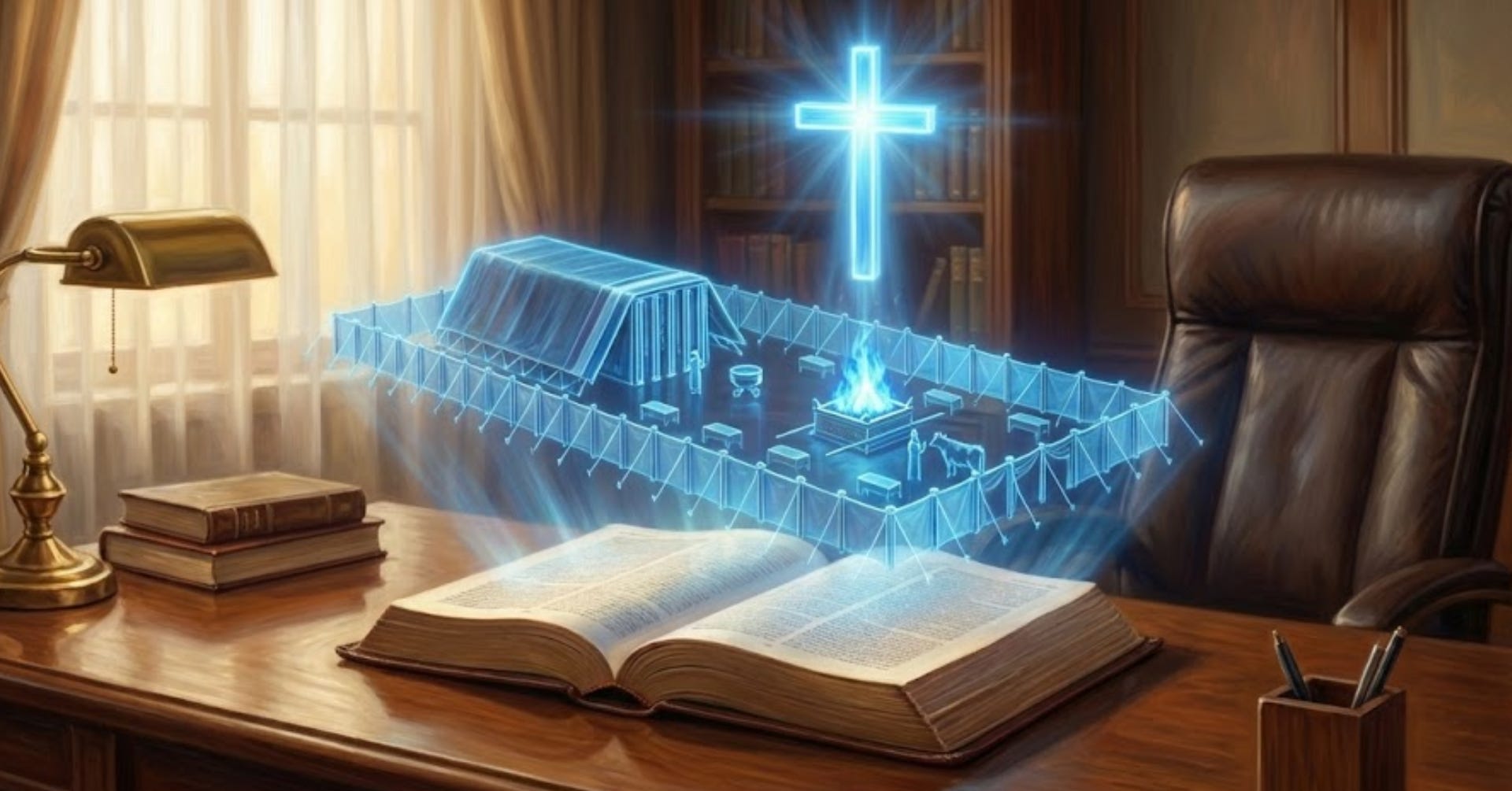
Ever tried navigating Los Angeles with San Francisco map data loaded in your GPS?
I haven’t either. But picture it for a second. You’re driving around downtown LA, confident you’re headed the right direction because your GPS says so. But the street names don’t match. The landmarks are wrong. Everything feels off.
The problem? Your GPS thinks you’re in San Francisco. And no amount of effort, determination, or positive attitude is going to fix that. The fundamental issue isn’t your driving—it’s the wrong map data.
Here’s what I’ve discovered about Bible study: Most Christians are doing exactly this. They’re navigating Scripture with the wrong framework.
You have the right destination—deeper understanding of God’s Word. You’re willing to do the work. You’re genuinely hungry for truth. But you’ve been given interpretive frameworks that don’t match the territory.
Sound familiar?
You sit through a prophecy seminar expecting clarity, but the interpretation requires artificial gaps in prophecies that seem to flow continuously. You study Hebrews and sense profound connections between Old and New Testament, but your framework can’t explain why God gave such detailed instructions for a sanctuary that was supposedly temporary. You read about Christ’s high priestly ministry and wonder what He’s actually doing in heaven right now—but nobody seems to have a clear answer.
You sense you should be making progress. But somehow you keep ending up confused.
Let me tell you something: The problem isn’t Scripture. God’s Word is perfectly consistent. The problem isn’t you—your spiritual commitment or intellectual capacity. I’ve worked with enough Truth Prospectors to know you’re probably more rigorous and hungry than most people sitting in church pews.
The problem is the map data. You’re trying to navigate biblical truth using frameworks that weren’t designed to handle what God actually revealed.
What if I told you there’s a different framework? One God Himself embedded in Scripture. One that makes Leviticus suddenly relevant, prophecy suddenly clear, and the whole Bible suddenly unified.
The third foundational pillar of biblical study is this: The Sanctuary IS the Map. Not a useful study tool. Not one interesting framework among many. THE map—the God-given blueprint that organizes and harmonizes all of Scripture.
Once you learn to use it, everything clicks into place.
Why You Need the Right Map
Let me ask you something.
When you read Leviticus, what do you see?
Be honest. Most Christians see boring ritual regulations about animal sacrifices. Ancient Jewish stuff that doesn’t apply anymore. Material you skip to get to the “good parts.”
When you hit those chapters about the tabernacle in Exodus—all those measurements, the specific furniture, the precise instructions for the priests—what’s your reaction?
For most people: “Why is this even in the Bible? Why do I need to know the exact dimensions of the altar?”
I used to think the same thing. God included this because it was historically important for Israel, but not really relevant for me. I’d skim through it to get to Moses and the Ten Commandments.
I was completely missing the point.
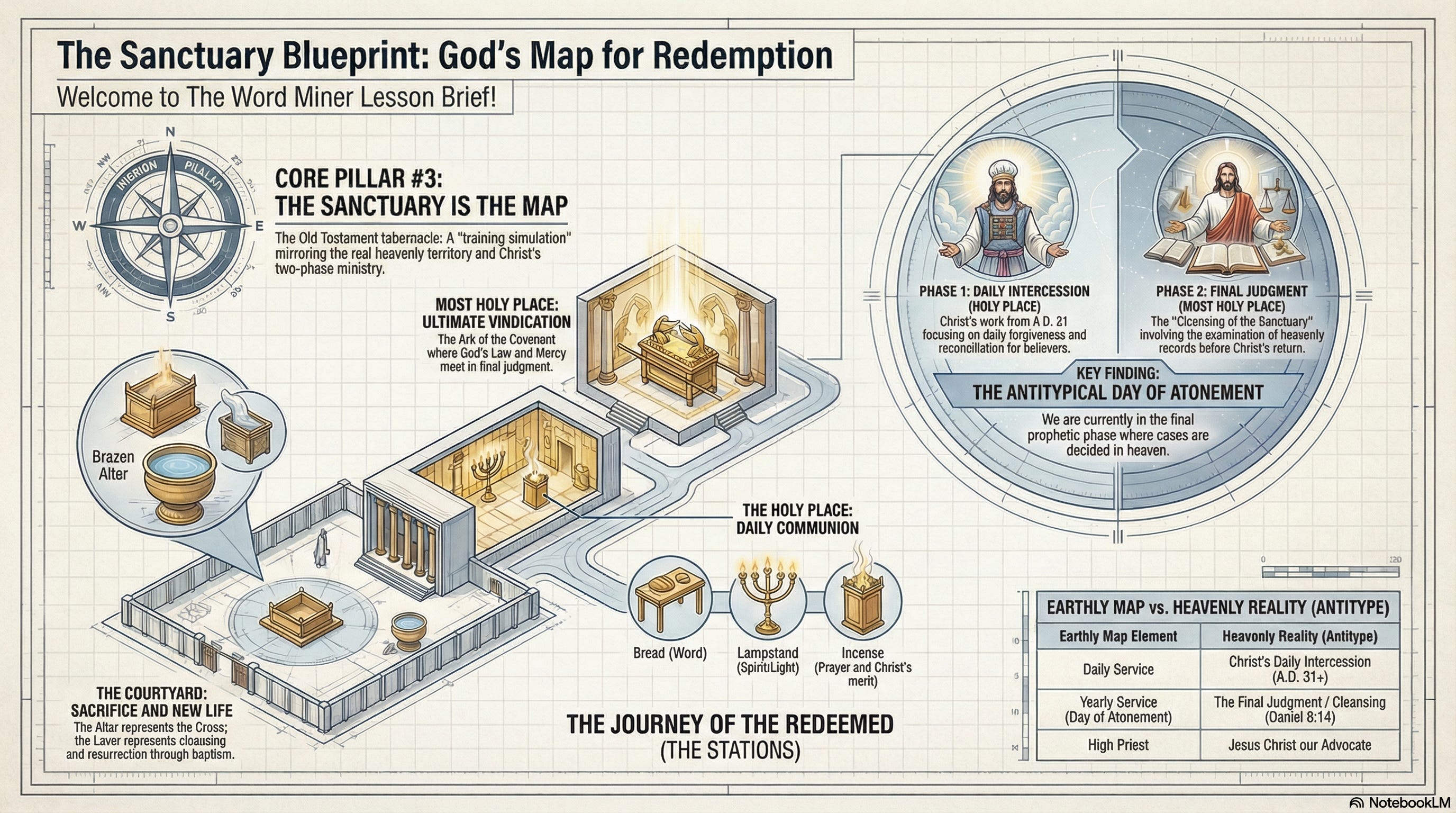
Those chapters aren’t just historical records. They’re a blueprint. A divine training simulation. A three-dimensional map of the entire plan of salvation.
The writer of Hebrews makes this explicit:
Now this is the main point of the things we are saying: We have such a High Priest, who is seated at the right hand of the throne of the Majesty in the heavens, a Minister of the sanctuary and of the true tabernacle which the Lord erected, and not man. (Hebrews 8:1-2, NKJV)
There’s a sanctuary in heaven. Jesus is ministering there right now.
And everything about the earthly sanctuary—every piece of furniture, every sacrifice, every service, every detail God commanded Moses to build—was designed to show you what Christ is doing in that heavenly reality.
The earthly sanctuary is the map. The heavenly sanctuary is the territory.
If you want to understand where Jesus is and what He’s doing in His ministry on your behalf, you need to learn to read the map.
The Day Everything Changed for Me
I need to tell you about a specific moment that revolutionized my entire Bible study.
FOB Frontenac, Afghanistan. Spring 2012.
I was sitting in a chapel service, listening to a chaplain preach about heaven from Revelation 21. He painted beautiful word pictures—streets of gold, gates of pearl—and while I appreciated his sincerity, something about the interpretation felt incomplete. Not wrong, necessarily, but it seemed like he was describing a vacation destination rather than revealing the culmination of God’s redemptive plan.
That night, back in my quarters, I spread open my Bible to Revelation 21 and began reading—really reading—not skimming for devotional thoughts.
But instead of just reading that chapter in isolation, the Holy Spirit brought other passages to mind. What about those precise instructions God gave Moses for the tabernacle in Exodus 25? What about Ezekiel’s intricate temple vision in chapters 40-48? What about Hebrews 8-10, with its discussion of heavenly and earthly sanctuaries?
For the first time, I saw connections I’d never noticed.
Could it be that the same God who had given such exacting specifications for an earthly dwelling place was describing the ultimate dwelling place in Revelation? Were these symbols just arbitrary decorative elements, or could they be consistent threads woven throughout Scripture, pointing to realities I was just beginning to glimpse?
I opened to Hebrews 8:1-2:
Now this is the main point of the things we are saying: We have such a High Priest, who is seated at the right hand of the throne of the Majesty in the heavens, a Minister of the sanctuary and of the true tabernacle which the Lord erected, and not man.
It hit me like a physical blow.
There’s a sanctuary in heaven.
Not metaphorical. Not symbolic. The text says there’s a literal sanctuary where God dwells, and Jesus—our High Priest—is ministering there. Right now.
If there’s a heavenly sanctuary, and the earthly sanctuary was built according to the pattern shown to Moses on the mountain (Exodus 25:40), then the earthly sanctuary is a copy. A training model. A map showing what’s happening in the heavenly reality.
Everything in Leviticus suddenly mattered.
Every sacrifice pointed to Christ’s death. Every priestly service pointed to Christ’s ministry. Every piece of furniture revealed a phase of redemption. The whole system was a compacted prophecy of the gospel—a visual, systematic revelation of how God saves.
I sat hunched over my Bible that night with a pen and concordance, flipping back and forth between Exodus, Leviticus, and Hebrews, watching the connections explode across the pages.
Same Bible I’d always had. But now I had the map.
The Pattern Shown on the Mountain
Let me show you something that changes how you read the entire Old Testament.
When God told Moses to build the tabernacle, He didn’t say, “Design something that seems appropriate for worship.” He said:
See that you make all things according to the pattern shown you on the mountain. (Hebrews 8:5, citing Exodus 25:40, NKJV)
The pattern.
Moses didn’t invent the sanctuary design. He was shown a model—either a miniature or a vision—of the heavenly sanctuary and instructed to replicate it on earth.
Think about what that means.
The heavenly sanctuary existed before the earthly one. It’s the original. The reality. The true tabernacle “which the Lord erected, and not man.”
The earthly sanctuary is the copy. The shadow. The training simulation.
Paul makes this explicit:
For Christ has not entered the holy places made with hands, which are copies of the true, but into heaven itself, now to appear in the presence of God for us. (Hebrews 9:24, NKJV)
Copies of the true.
So here’s the principle: By studying the visible, earthly sanctuary services, you can understand the invisible, heavenly ministry of Jesus. The type reveals the antitype. The shadow points to the substance. The map shows you the territory.
This isn’t an allegory where you impose symbolic meaning. This is vertical typology—recognizing that God Himself designed the earthly system to reveal the heavenly reality.
Want to know where Jesus is right now? Look at the map.
Want to understand what phase of the plan of salvation we’re in? Look at the map.
Want to see how all the pieces of redemption fit together? Look at the map.
The Training Simulation
In the military, we use training simulations constantly. Before you operate real equipment in combat, you train on simulators. You learn the controls, practice the procedures, master the sequence—all in a controlled environment that mirrors the real thing.
The earthly sanctuary was God’s training simulation for Israel.
He was preparing them to understand what the Messiah would actually do when He came. Teaching them the principles of redemption through visual, tangible object lessons they could see, touch, and participate in.
Every day, Israelites brought sacrifices to the sanctuary. They confessed their sins over the animal. They watched it die in their place. They saw the blood applied to the altar. They received assurance of forgiveness.
They were learning the gospel.
Not through abstract theological lectures. Through participation in a divinely designed system that showed them: Sin requires death. Innocent blood must be shed. A substitute can die in your place. Confession transfers guilt to the sacrifice. God provides the means of forgiveness.
And they learned all these centuries before Jesus was born, died, and rose again.
The sanctuary was preparing them to recognize the Messiah when He came. Programming the correct map data into their spiritual GPS so they could navigate toward the truth.
The Two Apartments, Two Ministries
Here’s where the map becomes incredibly practical.
The earthly sanctuary had two apartments: the Holy Place and the Most Holy Place, separated by a veil.
And the Levitical service had two primary divisions: the Daily service and the Yearly service.
These two divisions map to two distinct phases of Christ’s heavenly ministry.
Stay with me, because this is going to connect things you’ve wondered about your whole Christian life.
Phase One: The Daily Ministry (The Holy Place)
In the earthly sanctuary, the Daily service happened every day of the year in the first apartment—the Holy Place.
Here’s what happened: When an Israelite sinned, they brought a sacrifice. They confessed their sin over the animal. The animal was killed. The priest took the blood and either sprinkled it in the Holy Place or ate the flesh of the offering, symbolically taking the sin upon himself.
Result? The sinner received forgiveness. Their sin was pardoned.
But notice something critical: The sin didn’t disappear. It was transferred from the sinner to the sanctuary. The blood carried it there. The sanctuary became symbolically defiled with the accumulated sins of the people.
Think of it like storing nuclear waste in a temporary containment facility. The waste is removed from the populated area (forgiveness for the sinner), but it’s still there, waiting for final disposal.
Now look at the heavenly reality.
When Jesus ascended to heaven in A.D. 31, He entered the heavenly Holy Place to begin His work as High Priest. He appears in the presence of God to plead His blood for penitent believers.
What’s the focus of this phase? Forgiveness. Reconciliation. Intercession.
When you confess your sin, Jesus presents His blood to the Father on your behalf. You receive pardon. You’re covered by His righteousness. Your relationship with God is maintained.
But the record of that sin remains in the books of heaven—transferred to the sanctuary through Christ’s intercession—awaiting the final judgment.
This is the phase the church has been in from Christ’s ascension until... well, that brings us to Phase Two.
Phase Two: The Yearly Ministry (The Most Holy Place)
Once a year—only once—on the Day of Atonement (Yom Kippur), the High Priest entered the second apartment: the Most Holy Place.
This wasn’t about forgiving new sins. This was about dealing with the accumulated record of forgiven sins. The High Priest sprinkled blood on the mercy seat, directly over the Law in the Ark of the Covenant, to cleanse the sanctuary itself.
Then came the scapegoat. The High Priest would confess all the sins of Israel over a live goat’s head and send it into the wilderness, symbolically removing the sins from the camp forever.
This was a day of judgment.
Any Israelite who didn’t “afflict their soul”—didn’t repent and search their heart—on this day was “cut off” from the people. It was serious. Final. Decisive.
The question being decided: Who truly belongs to God’s people? Whose repentance is genuine? Who will stand in the judgment?
Now look at the heavenly reality.
The writer of Hebrews tells us the heavenly sanctuary must also be cleansed:
Therefore it was necessary that the copies of the things in the heavens should be purified with these, but the heavenly things themselves with better sacrifices than these. (Hebrews 9:23, NKJV)
The heavenly sanctuary requires cleansing.
Not because it’s dirty. But because the record of sin transferred there through Christ’s intercession must be finally dealt with.
Scripture reveals that this cleansing involves an examination of books. Daniel saw this in vision:
I watched till thrones were put in place, and the Ancient of Days was seated; His garment was white as snow, and the hair of His head was like pure wool. His throne was a fiery flame, its wheels a burning fire; a fiery stream issued and came forth from before Him. A thousand thousands ministered to Him; ten thousand times ten thousand stood before Him. The court was seated, and the books were opened. (Daniel 7:9-10, NKJV)
The court was seated. The books were opened.
What books? Scripture identifies at least two:
The Book of Life—containing the names of those who claim a relationship with God. John saw this: “And I saw the dead, small and great, standing before God, and books were opened. And another book was opened, which is the Book of Life” (Revelation 20:12, NKJV).
The Book of Remembrance—recording the deeds of those who fear the Lord. “Then those who feared the LORD spoke to one another, and the LORD listened and heard them; so a book of remembrance was written before Him for those who fear the LORD and who meditate on His name” (Malachi 3:16, NKJV).
The examination of these books serves multiple purposes:
It vindicates God’s character before the watching universe—demonstrating that He is just when He justifies sinners through faith in Christ.
It separates genuine believers from false professors—determining whose names remain in the Book of Life and whose are blotted out.
It confirms the salvation of the righteous—establishing who will inherit eternal life when Christ returns.
And notice something critical: Peter tells us where this judgment begins.
For the time has come for judgment to begin at the house of God; and if it begins with us first, what will be the end of those who do not obey the gospel of God? (1 Peter 4:17, NKJV)
Judgment begins at the house of God. With believers. With the church. Not with the wicked world—that comes later. First, God examines the records of those who have claimed His name.
This is the final phase of Christ’s Most Holy Place ministry—the antitypical Day of Atonement when the heavenly sanctuary is cleansed, the books are examined, and cases are decided before He returns to earth.
The Prophecy: Daniel 8:14
Here’s where the sanctuary map becomes your key to unlocking one of Scripture’s most significant prophecies.
Daniel received a vision. Empires rising and falling. A little horn power attacking truth. And then this prophecy:
And he said to me, “For two thousand three hundred days; then the sanctuary shall be cleansed.” (Daniel 8:14, NKJV)
Then the sanctuary shall be cleansed.
Now, here’s where you need the map. Because Daniel isn’t talking about the earthly sanctuary—that was destroyed in A.D. 70 and never rebuilt. He’s talking about the heavenly sanctuary that must be cleansed.
And “cleansing the sanctuary” means what?
According to the map: the Day of Atonement.
The yearly service. The High Priest entering the Most Holy Place. The examination of records. The separation of true worshipers from false professors. The final dealing with sin before the sanctuary is vacated.
The prophecy is telling us that Christ’s ministry would eventually transition from Phase One (Daily ministry in the Holy Place) to Phase Two (the final work in the Most Holy Place).
Think about what this reveals. God didn’t just give us a map showing the pattern of Christ’s ministry. He gave us prophecy revealing that there would be a specific transition point—a moment when Christ would move from the Holy Place to the Most Holy Place to begin the final phase.
The sanctuary map helps you understand what the prophecy means.
Without the map, Daniel 8:14 is a puzzle. “Cleansed”? What does that mean? What sanctuary? Why does it need cleansing?
But with the map, you see it clearly. The cleansing is the antitypical Day of Atonement. The yearly service. The examination of the books. The final work before Christ returns.
Scripture prophesied a transition in Christ’s ministry. From the daily work of intercession to the final work of judgment. From the Holy Place to the Most Holy Place.
And whether you’re comfortable with specific prophetic timelines or not, the sanctuary map shows you what’s happening in heaven right now. Christ is performing the final phase of His high priestly ministry. The books are being examined. Judgment has begun at the house of God.
We’re living in the antitypical Day of Atonement.
Walking Through the Stations
Let me make this practical by walking you through the sanctuary itself. Because each piece of furniture represents a specific station in the journey of redemption.
Picture yourself as an Israelite approaching the sanctuary. You’re coming with sin weighing on your conscience. You need to meet with God. Here’s the path:
The Courtyard: Sacrifice and Cleansing
The Altar of Burnt Offering - You enter the courtyard and immediately encounter the bronze altar. Fire burns on it continually. This is where the sacrifice dies. Blood is poured out. The innocent dies for the guilty.
What does this represent? The Cross of Christ.
This is the starting point of redemption. Everything begins here. John the Baptist saw Jesus and declared, “Behold! The Lamb of God who takes away the sin of the world!” (John 1:29, NKJV).
Without the shedding of blood, there is no remission of sin. This altar shows you that your salvation cost something—the life of God’s own Son.
The Laver - Between the altar and the sanctuary tent stands a bronze basin filled with water for washing. The priests had to wash here before entering the Holy Place.
What does this represent? Cleansing. Resurrection. Baptism.
You’ve been justified at the altar through Christ’s sacrifice. Now you’re being prepared for service. Death to the old life, rising to the new. Paul wrote, “Therefore we were buried with Him through baptism into death, that just as Christ was raised from the dead by the glory of the Father, even so we also should walk in newness of life” (Romans 6:4, NKJV).
The Holy Place: Daily Communion
Now you enter the first apartment—the Holy Place. This represents your daily walk with Christ and His ongoing ministry of intercession.
The Table of Showbread - On the north side, twelve loaves of unleavened bread arranged in two rows. Fresh bread placed here every Sabbath.
What does this represent? Jesus as the Bread of Life. The Word of God.
Jesus said, “I am the bread of life. He who comes to Me shall never hunger” (John 6:35, NKJV). Just as the bread was renewed every Sabbath, you need fresh feeding on Scripture constantly. Daily manna. Daily sustenance. The Word of God is your spiritual food.
The Golden Lampstand - On the south side, the seven-branched menorah burning continually. Filled with pure olive oil, tended by the priests.
What does this represent? Jesus as the Light of the World. The Holy Spirit.
Jesus said, “I am the light of the world. He who follows Me shall not walk in darkness, but have the light of life” (John 8:12, NKJV). The oil represents the Holy Spirit who illuminates truth and empowers witness.
Notice something important: This is the only light source in the sanctuary. No windows. No natural light. Only this lampstand.
Spiritual understanding comes only from God.
The Altar of Incense - Directly before the veil separating the Holy from the Most Holy Place, this golden altar stands. Sweet incense burns on it continually, its smoke ascending toward heaven.
What does this represent? Prayer. Christ’s intercession.
The smoke ascending represents your prayers mingled with the fragrant merit of Christ’s righteousness. John saw this in vision: “Then another angel, having a golden censer, came and stood at the altar. He was given much incense, that he should offer it with the prayers of all the saints upon the golden altar which was before the throne” (Revelation 8:3, NKJV).
Your prayers are acceptable to God because they’re mingled with Christ’s righteousness. This is the station of continual communion and intercession.
The Most Holy Place: Judgment and Vindication
Behind the second veil lies the Most Holy Place—the inner sanctuary entered only once a year by the High Priest on the Day of Atonement.
The Ark of the Covenant - The central object of the entire sanctuary system. A wooden chest overlaid with gold.
Inside the Ark: The Ten Commandments. The Law of God. The foundation of His government. The standard of His character. The measure by which all will be judged.
On top of the Ark: The Mercy Seat. A golden cover with two cherubim facing each other, their wings overshadowing the space between them. This is where the High Priest sprinkled blood on the Day of Atonement.
What does this represent? God’s throne. The meeting place of justice and mercy.
The Law inside demands justice for sin. The blood sprinkled on the Mercy Seat provides mercy for the sinner. Paul wrote that God demonstrated His righteousness “that He might be just and the justifier of the one who has faith in Jesus” (Romans 3:26, NKJV).
Justice and mercy meet at the throne.
The cherubim looking down represent the watching universe—angels and unfallen beings interested in the plan of redemption, observing how God will solve the sin problem while maintaining His justice.
This is where the final work of atonement happens. Where the books are examined. Where cases are decided. Where God’s character is vindicated before the universe.
Can You See the Journey?
Sacrifice at the altar. Cleansing at the laver. Daily feeding on the Bread of Life. Walking in the Light of the Spirit. Continual prayer through Christ’s intercession. Final judgment where mercy covers justice.
That’s not just an ancient ritual. That’s the systematic plan of salvation mapped out in three dimensions.
And here’s what’s stunning: God designed this system over 3,400 years ago. He commanded Moses to build it with exacting specifications. Every detail mattered. Every measurement was precise. Every element had meaning.
Why?
Because He was programming the correct map data into the spiritual GPS of His people. He was giving them the framework to understand redemption before the Redeemer came. He was preparing them to recognize the Messiah when He appeared.
And He’s giving you the same map today.
Why This Matters Right Now
Let me bring this down to where you live.
The sanctuary map reveals that Christ’s ministry has two distinct phases. And Scripture teaches that judgment begins at the house of God—with believers, with the church, starting with those who have died and claimed God’s name.
What does that mean for you?
It means the Day of Atonement isn’t just ancient history. It’s a present reality in the heavenly sanctuary. Christ is performing the final work that the earthly High Priest symbolized when he entered the Most Holy Place.
In the earthly type, the Day of Atonement was a day of soul-searching. Israelites who didn’t afflict their souls were cut off. It wasn’t a day for business as usual. It was a day of reckoning.
The application isn’t complicated: This is the time to get serious about your relationship with God. Now is the time to confess unconfessed sin. Now is the time to allow the Holy Spirit to search your heart and reveal anything that’s standing between you and complete surrender to Christ.
This isn’t legalism. This is reality.
Solomon wrote: “For God will bring every work into judgment, including every secret thing, whether good or evil” (Ecclesiastes 12:14, NKJV).
Every work. Every secret thing.
But here’s the good news—and this is crucial: You’re not being judged by a hostile prosecutor. You’re being represented by your own Defense Attorney.
Jesus isn’t looking for reasons to exclude you. He’s pleading His own blood on your behalf. He’s covering you with His righteousness. He’s advocating for you before the Father and the watching universe.
Listen to how John describes it:
My little children, these things I write to you, so that you may not sin. And if anyone sins, we have an Advocate with the Father, Jesus Christ the righteous. And He Himself is the propitiation for our sins. (1 John 2:1-2, NKJV)
We have an Advocate. A lawyer. A defender. Someone standing in that Most Holy Place right now presenting your case.
The judgment isn’t designed to terrify you. It’s designed to vindicate God’s character and demonstrate to the universe that He is just when He justifies sinners through faith in Christ.
The Vindication of God’s Government
Here’s something most people miss about the sanctuary.
It’s not just about saving you. It’s about vindicating God.
Think about the cosmic conflict. Satan accused God of being unfair. He claimed God’s law was too restrictive. He said created beings couldn’t obey it. He portrayed God’s government as tyrannical.
God couldn’t just destroy Satan immediately. Why? Because that would have looked like silencing opposition through force. It would have made the accusation seem credible. It would have secured obedience through fear rather than love.
So God permitted the rebellion to mature. He let the universe see the true nature of Satan’s alternative government—the suffering, the death, the chaos, the selfishness that sin produces.
And now, in the judgment, He’s demonstrating—in full transparency before the watching universe—that He is just.
The judgment vindicates God’s character.
It proves He’s fair when He saves the penitent. It proves He’s just when He excludes the rebellious. It answers every question about sin and redemption. It silences Satan’s accusations.
Paul understood this. He wrote:
That You may be justified in Your words, and may overcome when You are judged. (Romans 3:4, NKJV)
God Himself is being judged. The universe is examining His handling of the sin problem. And the sanctuary service—culminating in the Day of Atonement—demonstrates His perfect justice and mercy.
When it’s over, when the books are examined and the verdict is rendered, the universe will never again question God’s government. They’ll see that He was fair, just, merciful, and loving through the entire process.
And affliction will not rise up a second time.
The Scapegoat: Final Disposal
There’s one more element of the Day of Atonement that we need to understand, because it reveals the final step in God’s plan.
After the High Priest cleansed the sanctuary and sprinkled blood on the mercy seat, he came out and performed one final act. He took a live goat—the scapegoat, called Azazel in Hebrew—and confessed all the sins of Israel over its head. Then he sent it into the wilderness to perish.
What does this represent?
The final placement of responsibility for sin back on Satan.
Think about it. The sins were forgiven at the altar throughout the year. They were transferred to the sanctuary through the priests’ ministry. They were dealt with in the judgment in the Most Holy Place.
But one question remains: Who started all this? Who is ultimately responsible for the existence of sin in the universe?
Satan. The originator of rebellion. The one who first chose to sin and then tempted others to join him.
The scapegoat represents the final act of the cosmic drama. After the righteous are saved and vindicated, after the wicked are judged and sentenced, the responsibility for the instigation of sin is placed back on the one who started it all.
Satan will bear the full weight of what his rebellion has caused. Not because he’s a savior—Christ alone is Savior. But because he’s the instigator, and justice requires that he bear the ultimate responsibility for his actions.
This vindicates God completely. The universe sees that God didn’t create sin. He didn’t cause rebellion. He provided the solution, paid the price for redemption, and finally places the blame where it belongs.
Your Mission: Learn to Read the Map
So here’s what I’m asking you to do.
Don’t take my word for any of this. Go study it yourself.
Read Exodus 25-40. Study the tabernacle construction. Pay attention to every detail God commanded. Ask yourself: Why did God care so much about the exact specifications? What was He trying to show?
Read Leviticus 1-16. Study the sacrifices and the services. Don’t skim it. Dig into it. Ask: What does each sacrifice reveal about Christ? What does each service show about redemption? What’s the difference between the daily and the yearly?
Read Hebrews. Watch how the writer connects the earthly sanctuary to Christ’s heavenly ministry. See how he uses the language of the tabernacle to explain what Jesus is doing right now. Notice how often he says “better”—better covenant, better promises, better sacrifice, better tabernacle.
Read Daniel 8 and 9. Trace the prophecies. Calculate the timelines. See how they connect to the sanctuary services. Verify whether the interpretation holds up under scrutiny.
Use the map to navigate Scripture.
When you read about the Passover in Exodus, ask: How does this point to Christ our Passover Lamb? How does the blood on the doorposts connect to the blood on the altar?
When you read about the Day of Atonement in Leviticus 16, ask: What does this reveal about the final judgment? What’s the significance of the High Priest entering the Most Holy Place only once a year?
When you read Revelation and see references to the temple, the altar, the incense, the ark—recognize that John is describing heavenly sanctuary scenes. He’s showing you where Jesus is and what He’s doing.
When you read Paul’s letters and he talks about justification, sanctification, and glorification—see how these map to the stations in the sanctuary. Justification at the altar. Sanctification in the Holy Place. Glorification when Christ emerges from the Most Holy Place at the Second Coming.
The sanctuary is the framework that organizes everything.
It’s the blueprint that harmonizes law, prophecy, gospel, and judgment into one unified system. It’s the map that shows you where you are, where you’re going, and how to get there.
And once you learn to read it, you’ll never be lost in Scripture again.
The Difference It Makes
Let me tell you what happened after that night at FOB Frontenac.
Bible study became three-dimensional. Prophecy made sense. The connection between Old and New Testament became crystal clear. The plan of salvation wasn’t just a series of doctrines anymore—it was a systematic, visual, step-by-step journey I could trace through Scripture.
Leviticus stopped being boring ritual and became the most detailed revelation of Christ’s ministry available in the Old Testament. Every chapter had meaning. Every regulation pointed to something. Every sacrifice revealed another facet of redemption.
Daniel and Revelation stopped being cryptic puzzles and became clear prophetic timelines showing God’s people exactly where they are in history. The beasts made sense. The time prophecies connected. The sanctuary references throughout Revelation became navigation markers instead of mysteries.
The law stopped being a burden and became a revelation of God’s character and the standard of His throne. When I read the Ten Commandments, I wasn’t just seeing rules—I was seeing what’s written inside the Ark in the Most Holy Place, the foundation of God’s government, the measure by which the universe is judged.
The gospel stopped being just “Jesus died for my sins” and became the full panorama of Christ’s complete work—past, present, and future. Death at the altar. Ministry in the Holy Place. Judgment in the Most Holy Place. Return from the sanctuary at the Second Coming.
Everything connected.
And I finally understood what Jesus meant when He opened the disciples’ understanding on the road to Emmaus. When you see how it all fits together—when you have the map—your heart burns.
Not because you’ve mastered some complex theological system. But because you’ve encountered the living Christ in the blueprint He designed to reveal Himself.
Recalibrating Your Framework
Remember that frustrated driver in Los Angeles trying to navigate with a San Francisco map?
The problem wasn’t effort. Wasn’t attitude. Wasn’t determination.
The problem was the wrong navigational framework.
You can work harder at Bible study. You can maintain a positive attitude about your spiritual growth. You can be determined to understand prophecy.
But if you’re using the wrong interpretive framework—if you’re trying to navigate biblical truth with map data that doesn’t match the terrain—you’re going to keep ending up confused.
The solution isn’t trying harder. It’s recalibrating your framework.
Let God reprogram your spiritual GPS with the map He designed.
The sanctuary isn’t one option among many. It’s not a denominational distinctive you can take or leave. It’s not an interesting study topic for those who like ancient history.
It’s the framework God Himself embedded in Scripture to organize all biblical truth.
And until you learn to use it, you’ll continue experiencing that same frustration as our driver in LA—sensing you should be making progress but somehow ending up in places you never intended to go.
Your Coordinates
So where are you?
Spiritually, I mean. Where are you on the map?
Have you approached the altar? Have you accepted Christ’s sacrifice on your behalf? Have you acknowledged that you can’t save yourself, that you need the blood of the Lamb?
Have you been cleansed at the laver? Have you died to the old life and risen to the new? Have you experienced the resurrection power of Christ?
Are you daily feeding on the Bread of Life—studying Scripture, growing in grace, allowing the Word to transform your thinking?
Are you walking in the light of the Spirit, bearing witness to the truth, letting God’s light shine through you to others?
Are you maintaining constant communion through prayer, approaching the throne of grace with confidence because your prayers are mingled with Christ’s righteousness?
And are you ready for the judgment? Have you allowed the Holy Spirit to search your heart? Are you cooperating with Christ’s work of preparing you to stand in that final day? Are you covered by the blood of the Lamb?
The map shows you where you need to go. But you have to walk the path.
This isn’t passive. This isn’t just intellectual knowledge about the sanctuary system. This is active participation in the plan of redemption.
You have a High Priest in the heavenly sanctuary right now, working on your behalf. He’s interceding for you. He’s covering you with His righteousness. He’s preparing to present you faultless before the Father.
But you have to cooperate. You have to surrender. You have to let Him complete His work in you.
The Map Is Yours
I’m going to leave you with this.
God didn’t hide the map. He didn’t make it obscure. He didn’t reserve it for scholars or theologians or people with seminary degrees.
He gave it to a nation of former slaves in the wilderness. He made it visual, tangible, systematic. He built it in three dimensions so even children could understand the basic concepts.
He commanded it to be set up in the center of the camp where everyone could see it. He had the priests perform the services publicly so the people could watch and learn. He instituted feast days that required participation so families would teach their children what it all meant.
The map is yours. Use it.
Study the sanctuary. Let it organize your understanding of Scripture. Let it show you where Christ is and what He’s doing. Let it reveal the systematic beauty of the plan of redemption.
And when someone asks you, “How do all these pieces of the Bible fit together? How does the Old Testament connect to the New? How does law relate to grace? How does prophecy fit with the gospel?”—you’ll have an answer.
Not a theory. Not a guess. A map.
The map God Himself designed and gave to His people to guide them home.
Let us therefore come boldly to the throne of grace, that we may obtain mercy and find grace to help in time of need. (Hebrews 4:16, NKJV)
Your High Priest is at the throne right now. In the Most Holy Place. Interceding on your behalf. Covering you with His righteousness. Preparing you for His return.
The sanctuary is open.
The way has been made clear.
The map is in your hands.
Now navigate by it.
And come home.
Let us therefore come boldly to the throne of grace, that we may obtain mercy and find grace to help in time of need. (Hebrews 4:16, NKJV)

Ready for Biblical Study That Goes Deeper Than Sunday School?
Join Truth Prospectors receiving systematic biblical teaching using Scripture-interpreting-Scripture methodology. No denominational filters. No shallow devotionals. Just the authority of God’s Word unlocking Christ’s complete ministry through the Sanctuary framework.
The Word Miner Ministries Resource
LISTEN to The Word Miner Podcast
Tired of surface-level Bible teaching? Join us as we tactically mine Scripture’s hidden treasures through sanctuary-based interpretation. Discover how systematic Bible study reveals Christ’s complete ministry and empowers you to unearth profound truths that denominational traditions often miss.

Your spiritual expedition begins now.
READ Our Daily Devotional: The Daily Shekinah Revival
Daily devotions restoring God’s glory within. A biblical devotional series that guides Truth Prospectors through daily encounters with God’s presence, using sanctuary typology and Scripture-centered teaching to restore authentic spiritual revival in the believer’s heart and life.

Read our daily devotional today!
GET The Book: THE WAY: Discovering God’s Blueprint

What if the Bible’s greatest interpretive key has been hiding in plain sight—and once you see it, Scripture will never look scattered again?
The Biblical Sanctuary: God’s own architectural blueprint embedded in Scripture from Genesis to Revelation is not a human system imposed on the text, but a divinely designed pattern that unlocks prophecy, reveals Christ’s ministry, and transforms fragmented knowledge into systematic understanding.
Connect With Us:
Find Us on Social Media:
Legal “Stuff”
© 2026 The Word Miner Ministries