

Listen to Audio “Deep Dive” Discussion.
Download The Discussion “Slide Deck.”
Has someone ever looked you in the eye — maybe across a Bible study table, maybe from behind a pulpit, maybe in the comment section of a video you watched at midnight — and said something like this: “The Flood didn’t literally happen. It’s just a story meant to teach us about God’s judgment.” Or: “You don’t have to believe Jonah was actually swallowed by a fish. What matters is the spiritual meaning.” Or: “Genesis 1 isn’t meant to be taken as real history — it’s a theological poem.”
And maybe — if you’re being completely honest — some part of you felt the pull of that argument. Because the person saying it sounded educated. They used words like “genre” and “hermeneutics” and “ancient Near Eastern literary conventions.” They seemed serious about the Bible. And for a moment, you wondered: Is there a way to hold onto the theology without having to defend the history?
I want to sit with that question for a few minutes before we go anywhere else today. Because what’s actually being proposed in that moment is one of the most significant — and most dangerous — trade-offs in the entire history of Christian thought.
And the Bible itself has a very clear answer.
The Intelligence Failure That Changes Everything
Let me put the stakes in terms that will make the problem immediately clear.
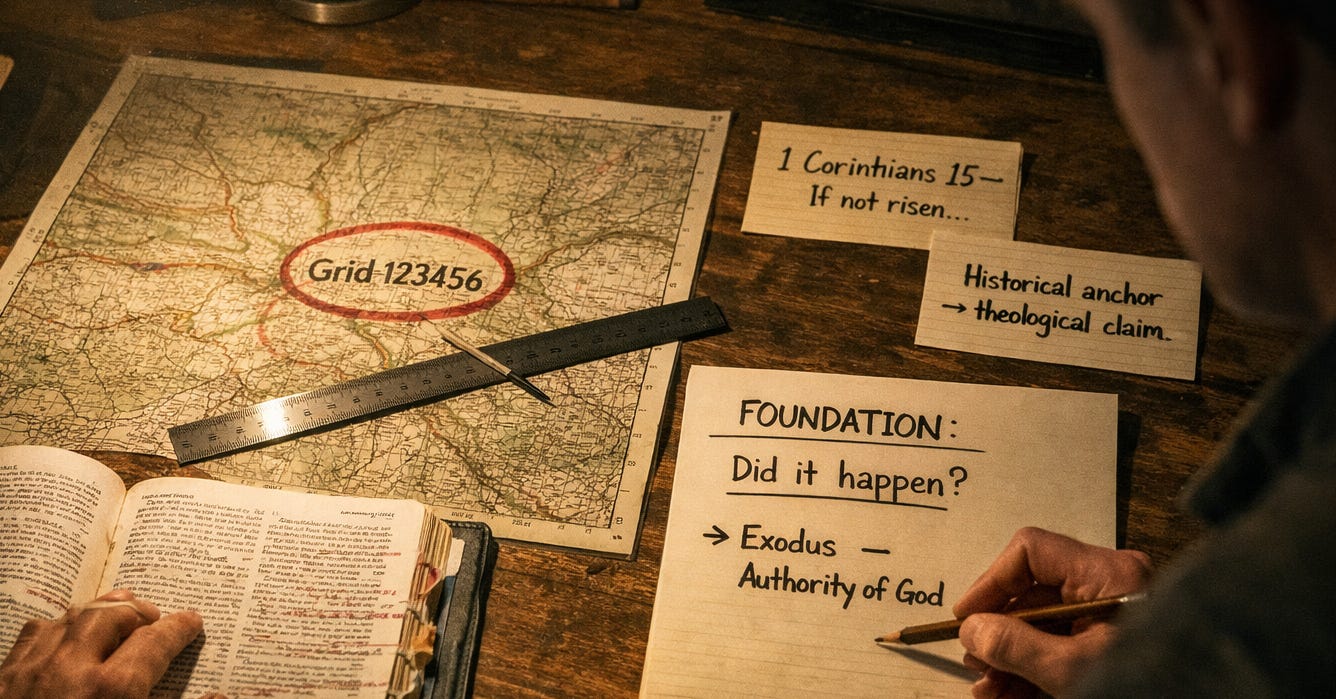
In military intelligence operations, the accuracy of your reconnaissance is not a secondary concern. It is the foundation on which every tactical decision rests. Before any mission is launched, the intelligence officers must answer a critical question: Where is the enemy? The grid coordinate they place on the map — the specific location they designate as the target — determines everything that happens next. Troop movements. Air support calls. Fire support coordinates. The entire operation is built on that one piece of intelligence.
Now consider what happens if the intelligence is wrong.
If the report says the enemy is at Grid 123456 and they are not at Grid 123456 — if the reconnaissance was flawed, if the coordinates were misread, if the map was outdated — the entire operation does not simply become less effective. It collapses. Units move to the wrong location. Fire support hits empty ground. The actual threat, undetected and unengaged, remains fully operational. And worse, the soldiers who trusted that bad intelligence are now exposed, vulnerable, and fighting a battle based on a reality that does not exist.
Bad intelligence does not just produce a suboptimal outcome. It produces catastrophic failure.
This is precisely what the study notes establish as the foundational principle of Historical Reconnaissance in biblical interpretation: bad history produces bad theology. Not slightly compromised theology. Not theology with minor adjustments required. Theology that collapses at its foundation — because every doctrinal structure the Bible builds rests on the question of whether the historical events it describes actually happened.
The problem is not theoretical. It is happening in real time, in churches, in seminaries, in Bible studies, and in the minds of sincere Truth Prospectors who have been handed a framework that sounds sophisticated but is, at its core, an intelligence failure with eternal consequences.
The Theory: History and Theology Cannot Be Divorced
Since the Enlightenment — roughly the seventeenth and eighteenth centuries — a movement in European biblical scholarship began to apply the tools of naturalistic historical analysis to the biblical text. The goal, stated openly, was to recover the “real” history behind the biblical narrative by stripping away what these scholars considered to be later theological embellishment, legendary accretion, and supernatural invention.
This produced a critical distinction that you need to know by name, because you will encounter it — or its consequences — every time someone argues that a biblical event is “just symbolic.”
German scholarship developed two terms: Historie and Geschichte.
Historie refers to the actual, verifiable facts and events of the past — what happened in real time and space. Geschichte refers to the theological interpretation of those events — the meaning that the biblical writers attached to history. The move these scholars made was to argue that the Geschichte — the theological message — could be preserved and preached even if the Historie — the actual event — never occurred. The “kerygmatic content” of the story (its proclaimed theological significance) was what mattered, completely decoupled from the question of whether the event took place.
This sounds sophisticated. It is, in fact, a trap.
Because the Bible does not permit this separation. The biblical worldview does not present God as an abstract philosophical concept whose character can be communicated through fictional stories. The biblical God is a personal God who reveals Himself through His actions in real, linear, verifiable human history. His credibility, His authority, His covenant promises — all of them are explicitly anchored to specific things He actually did at specific times in specific places.
If those things did not happen — if the history is fictional — then the God who said He did them is not telling the truth. And a God who does not tell the truth about the past has given you no rational basis to trust His promises about the future.
The Bible makes this connection with absolute clarity. Remove the historical event, and you do not preserve the theology in a purer, less encumbered form. You destroy the theology entirely. The Geschichte without the Historie is not Christianity. It is a story about a God who never actually showed up.
The Two Test Cases Scripture Itself Provides
Two texts function as the Bible’s own definitive answer to this question — one from the Old Testament, one from the New. Together they establish that the claim “the history must be real or the theology is void” is not a modern conservative overcorrection. It is the consistent, non-negotiable position of Scripture itself.
Exodus 20:2 — God’s Identity Anchored to History
“I am the LORD your God, who brought you out of the land of Egypt, out of the house of bondage” (Exodus 20:2, NKJV).
Read that carefully. This is the opening declaration of the Ten Commandments — the foundational document of Israel’s entire covenant relationship with God. And notice how God introduces Himself.
He does not open with a philosophical statement about His nature. He does not say “I am the eternal, self-existent, omnipotent Being.” He opens with a historical claim. He anchors His authority, His right to speak, and His right to command Israel’s complete allegiance to a specific historical event: the Exodus from Egypt.
This pattern is not limited to Exodus 20. It repeats throughout the Old Testament with striking frequency. “I am the LORD your God, who brought you out of the land of Egypt” appears, in various forms, dozens of times across the Pentateuch, the historical books, and the prophets. God’s self-identification is inseparable from what He actually did in history.
Now press the question directly: What happens to this declaration if the Exodus never occurred?
If there was no departure from Egypt — if no sea parted, if no plagues fell, if no people walked out of bondage into freedom — then God’s foundational self-identification in Exodus 20:2 is based on a fiction. His claim to sovereignty is grounded in an event that He did not actually accomplish. His authority to issue the Ten Commandments evaporates, because the historical credential He presents in support of that authority does not exist.
The theology does not survive the removal of the history. The declaration “I brought you out” is either a historical statement about something God actually did, or it is a theological fraud. There is no middle position that preserves the meaning while eliminating the event.
1 Corinthians 15:14-17 — The Keystone That Holds Everything
The New Testament’s answer to this question is, if anything, even more direct. In First Corinthians chapter 15, the Apostle Paul is responding to a group within the Corinthian church who apparently believed in some kind of spiritual resurrection while denying the possibility of bodily resurrection from the dead. Paul dismantles their position with a logic that is both simple and devastating:
“And if Christ is not risen, then our preaching is empty and your faith is also empty... And if Christ is not risen, your faith is futile; you are still in your sins!” (1 Corinthians 15:14, 17, NKJV).
Paul does not soften this. He does not say “the resurrection is primarily a spiritual reality that transcends the question of whether it happened physically.” He says: if the historical, bodily resurrection of Jesus Christ did not actually occur in real time and space — if the tomb was not genuinely empty on the third day, if the physical body of Jesus was not actually raised — then Christian preaching is empty, Christian faith is futile, and every believer who has ever placed their trust in Christ is still dead in their sins.
This is Paul’s direct application of the principle the tactical analogy established: the intelligence report must be accurate, or the entire operation fails.
The resurrection is not a theological concept that floats free of historical verification. It is a claim about something that actually happened — and if it did not actually happen, every theological conclusion built on it is worthless. The Geschichte (the theological message of resurrection hope) cannot be preserved by eliminating the Historie (the actual, empty tomb). Remove the history, and you do not have a purer theology. You have, in Paul’s exact words, an “empty” message and a “futile” faith.
Skill Development: Tracing Historical Events to Their Theological Roots
Understanding why history matters is one thing. Developing the skill to trace it — to follow a specific historical event through Scripture and watch the theological significance compound across multiple books and centuries — is another. This is the skill this lesson builds.
The principle that governs it is straightforward: the biblical writers universally accepted the historical accounts of previous authors as factual events upon which they built their theology. They did not treat earlier Scripture as legendary material that could be demythologized for a more sophisticated audience. They treated it as the reliable record of what God actually did — and they built their theology on that foundation.
Consider how this works with a specific example: the historical event of the Exodus.
Out of the 2,688 times the Old Testament is referenced in the New Testament, the Exodus is quoted or referenced approximately 220 times. That density of cross-referential usage is not accidental. The biblical writers returned to the Exodus repeatedly because it was the paradigmatic act of God’s redemptive power — the template against which every subsequent act of divine deliverance was measured.
In Psalm 78, the psalmist rehearses the specific, concrete historical facts of the Exodus — the plagues, the parting of the sea, the wilderness provision — not as illustrative mythology but as the actual track record of God’s covenant faithfulness. The theological point (God is faithful to His covenant people) depends entirely on the historical point (God actually did these things for their ancestors).
In Acts chapter 7, verses 30 through 36, Stephen stands before the Sanhedrin and delivers a sweeping survey of Israel’s history. He treats Moses, the burning bush, the plagues, and the Red Sea crossing with the same matter-of-fact historical confidence he would use to describe the Roman occupation of Jerusalem. These are facts, not parables. And he uses them to build a theological argument that would cost him his life.
In First Corinthians chapter 10, verses 1 through 4, Paul explicitly calls the historical events of the Exodus “types” — acted parables, divinely orchestrated historical events that prefigure theological realities. He says the Israelites literally passed through the sea, literally ate the manna, literally drank from the smitten rock. And then — crucially — he states that “that Rock was Christ.” Paul traces a historical event to its ultimate theological fulfillment in the person of Jesus. But the typology only works if the type is real. A fictional prefiguration of a real fulfillment is not typology. It is coincidence at best, deception at worst.
In Hebrews chapter 11, verses 28 and 29, the author of Hebrews lists the faith of the Exodus generation among the greatest examples of trust in God’s Word in all of biblical history. He affirms with precision: “by faith they passed through the Red Sea as by dry land, whereas the Egyptians, attempting to do so, were drowned.” This is not the language of parable or metaphor. This is the language of historical record — treated as such by an inspired New Testament writer.
The pattern across all four passages is identical: later Scripture builds its theology on earlier history, treating that history as factually reliable. The theological edifice — God’s covenant faithfulness, the typological foreshadowing of Christ’s redemption, the model of saving faith — stands only because the historical foundation is solid.
Remove the historical foundation, and every floor of the theological structure above it collapses.
Live Fire Exercise: Charting the Exodus Through Scripture
The tactical assignment for this week is specific, systematic, and requires that you do the actual work rather than simply agreeing with the principle.
Open your Bible to Exodus chapters 12 through 15. Read slowly and chart the historical details as you encounter them — the specific instructions for the Passover lamb, the ten plagues, the departure from Egypt, the pursuit by Pharaoh’s army, the parting of the Red Sea, the destruction of the Egyptian forces, the song of Moses on the far shore. Do not skim. Chart the concrete, specific, time-and-space details that the text records.
Then open each of the following passages and document precisely how they treat the Exodus events you charted:
Psalm 78 — which historical details does the psalmist specifically reference, and what theological argument does he build from them?
Acts chapter 7, verses 30 through 36 — how does Stephen treat the Exodus in his defense before the Sanhedrin?
First Corinthians chapter 10, verses 1 through 4 — what historical events does Paul identify as “types,” and what is the theological point he extracts from each?
Hebrews chapter 11, verses 28 and 29 — how does the author describe the Exodus events, and what does this reveal about his confidence in their historical reality?
For each passage, document one specific question: What theological point being made here collapses if the Exodus event it references did not actually occur?
By the end of this exercise you will not simply believe that history matters to biblical theology. You will have traced the evidence yourself, from multiple angles, across multiple centuries of biblical writing, and arrived at the conclusion through your own investigation. That is the difference between received doctrine and proven conviction.
Application: Letting the Hermeneutics of Jesus Become Yours
The application assignment carries the most personal weight of anything in this lesson, because it moves from abstract principle to direct confrontation with something specific in your theological environment.
Identify one biblical event that someone — a teacher, a professor, a pastor, a family member, a skeptic — has told you is “just symbolic” or “a myth” or “not meant to be taken literally.” It might be the six-day Creation of Genesis 1. It might be the global Flood of Noah’s day. It might be the story of Jonah in the belly of the great fish. It might be the Exodus itself. Name the specific event and the specific claim made about it.
Then do the investigative work.
Study how Jesus treated that event. The record is clear and consistent. When the religious leaders of His day challenged Him about marriage and divorce, Jesus did not treat the Genesis account of creation as a symbolic story — He appealed to it as the factual historical record of what God actually did: “Have you not read that He who made them at the beginning ‘made them male and female’?” (Matthew 19:4, NKJV). When He wanted to establish the credibility of His resurrection prediction, He did not use a metaphor — He pointed to the historical experience of Jonah as a real man who spent three days in the belly of a real fish and emerged alive (Matthew 12:40). When He wanted to impress upon His listeners the sudden, catastrophic nature of His Second Coming, He cited the days of Noah and the Flood not as a legendary cautionary tale but as a literal historical event that established the pattern (Matthew 24:38-39).
Jesus — who is the Word made flesh, the One through whom all things were created, the One who was present at every event recorded in the Old Testament — treated those events as history. He never once applied a naturalistic hermeneutic to a biblical narrative. He never once suggested that the “spiritual meaning” could be preserved by jettisoning the historical reality.
Now ask yourself the confrontational question this application demands: If Jesus — who had every reason and every authority to correct the record — consistently treated these events as historical fact, on what basis do I accept a framework that treats them as myth?
Letting Jesus’ view become yours is not intellectual capitulation. It is the most rigorously logical position available — because the alternative is to adopt a hermeneutic that Jesus Himself did not practice. And adopting an interpretive framework that breaks from the hermeneutics of Jesus is not scholarship. It is a theological intelligence failure with consequences that extend to every doctrinal conclusion built downstream from that decision.
The biblical writers understood something that every Truth Prospector must eventually settle for themselves: the God of Scripture is not a God of abstract spiritual principles who communicated His character through pious fiction. He is the God who parted a sea. The God who raised a man from the dead on the third day. The God whose self-identification — whose covenant name, whose authority, whose claim on your life — is inseparable from what He actually did in real time and space.
That is either true, or it is not.
And if it is not — if the history is uncertain, negotiable, or symbolic — then neither is anything else. Because the God whose promises you are counting on for the future is the same God whose acts in the past are on the table.
The intelligence must be accurate. Conduct your reconnaissance accordingly.
Scripture References Used in This Essay: Exodus 12-15 | Exodus 20:2 | Psalm 78 | Matthew 12:40 | Matthew 19:4-5 | Matthew 24:38-39 | Acts 7:30-36 | Romans 5:12 | 1 Corinthians 10:1-4 | 1 Corinthians 15:14-17 | Hebrews 11:28-29
All Scripture quotations taken from the New King James Version (NKJV) © 1982 Thomas Nelson, Inc. or the New American Standard Bible 1995 Edition (NASB95) © The Lockman Foundation.
All interpretations presented are subject to Scripture itself as the ultimate authority. Readers are encouraged to verify all teaching through personal Bible study following the Berean example (Acts 17:11).
The Word Miner Ministries | thewordminer.org


Ready for Biblical Study That Goes Deeper Than Sunday School?
Join Truth Prospectors receiving systematic biblical teaching using Scripture-interpreting-Scripture methodology. No denominational filters. No shallow devotionals. Just the authority of God’s Word unlocking Christ’s complete ministry through the Sanctuary framework.
The Word Miner Ministries Resource
LISTEN to The Word Miner Podcast
Tired of surface-level Bible teaching? Join us as we tactically mine Scripture’s hidden treasures through sanctuary-based interpretation. Discover how systematic Bible study reveals Christ’s complete ministry and empowers you to unearth profound truths that denominational traditions often miss.

Your spiritual expedition begins now.
READ Our Daily Devotional: The Daily Shekinah Revival
Daily devotions restoring God’s glory within. A biblical devotional series that guides Truth Prospectors through daily encounters with God’s presence, using sanctuary typology and Scripture-centered teaching to restore authentic spiritual revival in the believer’s heart and life.

Read our daily devotional today!
GET The Book: THE WAY: Discovering God’s Blueprint

What if the Bible’s greatest interpretive key has been hiding in plain sight—and once you see it, Scripture will never look scattered again?
The Biblical Sanctuary: God’s own architectural blueprint embedded in Scripture from Genesis to Revelation is not a human system imposed on the text, but a divinely designed pattern that unlocks prophecy, reveals Christ’s ministry, and transforms fragmented knowledge into systematic understanding.
Connect With Us:
Find Us on Social Media:
Legal “Stuff”
© 2026 The Word Miner Ministries