

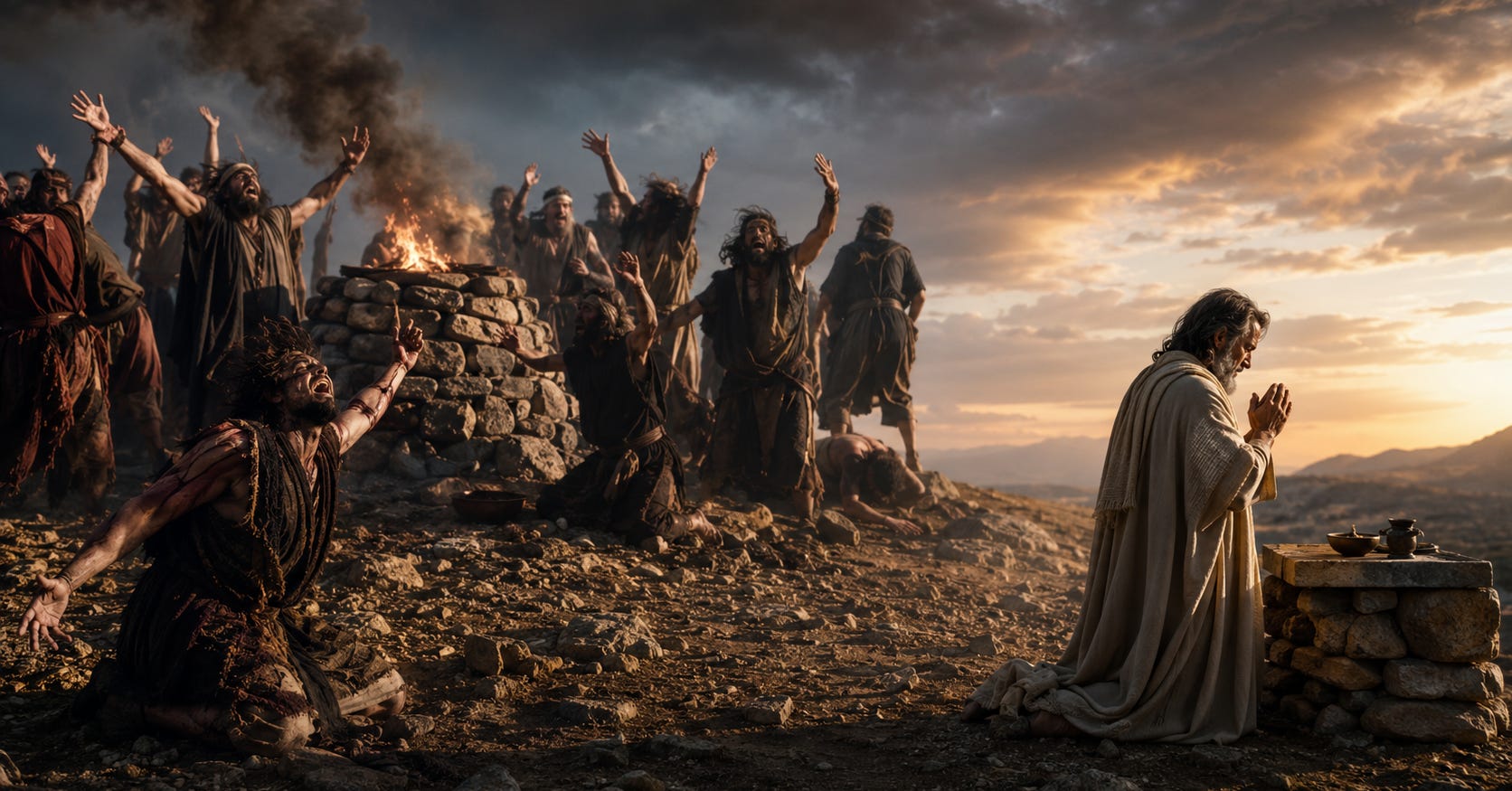
There is a scene that happens earlier on the same mountain range as Elijah’s quiet encounter, and it belongs right alongside it, because it shows the opposite instinct in full display. Four hundred and fifty prophets gather around an altar, and for hours they call out to their god, and when nothing happens, they escalate. They dance around the altar. They cry out louder. Eventually they cut themselves with knives and lances, according to their custom, until the blood flows, and they keep going, worked into a frenzy that lasts from morning until the time of the evening sacrifice.
Nobody watching that scene would have called it restrained. It had every marker a person might associate with overwhelming spiritual intensity: sustained emotional escalation, physical extremity, a complete abandonment of ordinary composure. And Scripture does not present any of that as evidence something real was happening. It presents it plainly: “they cried aloud, and cut themselves, as was their custom, with knives and lances, until the blood gushed out on them” (1 Kings 18:28, NKJV), noise, increasingly desperate noise, directed at something that was never listening in the first place.
That raises an uncomfortable question for anyone who has ever assumed that losing control of yourself is itself a sign of authenticity. If a person’s composure breaking down were proof of divine contact, the prophets of Baal would have had as strong a claim to it as anyone in Scripture. They did not lack intensity. They lacked a God who was actually there. Which means intensity, even extreme intensity, even intensity that costs a person physical pain to sustain, was never the thing separating real encounter from empty performance.
Compare that to what Paul tells the Corinthian church about how genuine prophetic gifts were supposed to function in their own gatherings, in a passage dealing with people who were interrupting each other, all convinced the Spirit had seized them and could not wait their turn. “And the spirits of the prophets are subject to the prophets” (1 Corinthians 14:32, NKJV). Read that carefully. Even under what Scripture treats as legitimate prophetic inspiration, the prophet remains the one in control of when to speak, not a passenger being overridden by a force too strong to manage. Whatever was happening to them, it never cost them their own agency in the process.
That single verse quietly dismantles an assumption a lot of people carry without examining it, the idea that the Spirit’s presence is measured by how completely it takes over. Paul describes the opposite pattern. The gift operates through the person, who remains responsible for how and when it is expressed, capable of waiting, capable of yielding the floor, capable of ordinary self-governance even in the middle of something extraordinary. If self-control disappears entirely, that is not a stronger indicator of the Spirit’s work. According to Paul’s own description, it is a departure from it.
This lines up with something easy to skip past in Paul’s list of what the Spirit actually produces in a person over time: “love, joy, peace, longsuffering, kindness, goodness, faithfulness, gentleness, self-control” (Galatians 5:22-23, NKJV). Self-control sits at the end of that list, not as an afterthought, but as part of the same fruit as love and peace. It is strange, if a person stops to think about it, that the same Spirit credited with producing self-control would also be the one responsible for stripping it away entirely in the moment of encountering Him. Those two claims do not sit comfortably together, and one of them has to give.
Paul makes a related claim to Timothy, describing what God has and has not given: “God has not given us a spirit of fear, but of power and of love and of a sound mind” (2 Timothy 1:7, NKJV). A sound mind. Not a mind overridden, not a mind swept past its own judgment, but a mind functioning clearly, strengthened rather than short-circuited. Whatever spirit produces confusion, loss of rational capacity, and behavior a person could not account for afterward, that description does not match what Timothy was told to expect from the genuine article.
None of this argues that real encounters with God are always calm, quiet, and undramatic. Scripture has plenty of examples of people trembling, weeping, falling to the ground in the presence of something overwhelming. The question was never whether emotion showed up. The question is what happened to a person’s mind and will while it did. Did they remain themselves, examined and moved but still present, still capable of ordinary judgment once the moment passed? Or did something take over that they could not later explain, could not account for, and would have no way of testing even if they wanted to?
The prophets of Baal never got an answer that day, no matter how far they pushed themselves past the point of composure. If the measure had been effort, or intensity, or willingness to abandon self-control entirely, they would have won by any standard a person could construct. What did their example fail to produce, and what would it have taken for you to notice the difference at the time?
Focus Verse: “And the spirits of the prophets are subject to the prophets.” — 1 Corinthians 14:32 (NKJV)
Ready for Biblical Study That Goes Deeper Than Sunday School?
Join Truth Prospectors receiving systematic biblical teaching using Scripture-interpreting-Scripture methodology. No denominational filters. No shallow devotionals. Just the authority of God’s Word unlocking Christ’s complete ministry through the Sanctuary framework.
The Word Miner Ministries Resources
LISTEN to The Word Miner Podcast
Tired of surface-level Bible teaching? Join us as we tactically mine Scripture’s hidden treasures through sanctuary-based interpretation. Discover how systematic Bible study reveals Christ’s complete ministry and empowers you to unearth profound truths that denominational traditions often miss.

READ Our Daily Devotional: The Daily Shekinah Revival
Daily devotions restoring God’s glory within. A biblical devotional series that guides Truth Prospectors through daily encounters with God’s presence, using sanctuary typology and Scripture-centered teaching to restore authentic spiritual revival in the believer’s heart and life.

GET The Book: THE WAY: Discovering God’s Blueprint
What if the Bible’s key has been hidden in plain sight? Once you see it, Scripture will no longer seem scattered.
Sincere believers have pieced together disconnected verses, endured shallow teachings, and seen interpretations fail. The answer is the Biblical Sanctuary: God’s divine blueprint in Scripture from Genesis to Revelation. It’s not a human system but a pattern that unlocks prophecy, reveals Christ’s ministry, and turns fragmented knowledge into understanding.
LEARN The Core Pillars of Bible Study
Want to dig deeper into these truths? Explore The Core Pillars of Bible Study. Discover how Christ is the Center of all interpretation, why The Sanctuary is the Map for understanding God’s Word, and learn how Scripture is the Authority that interprets itself.
Connect With Us:
Find Us on Social Media:
Legal “Stuff”
© 2026 The Word Miner Ministries