

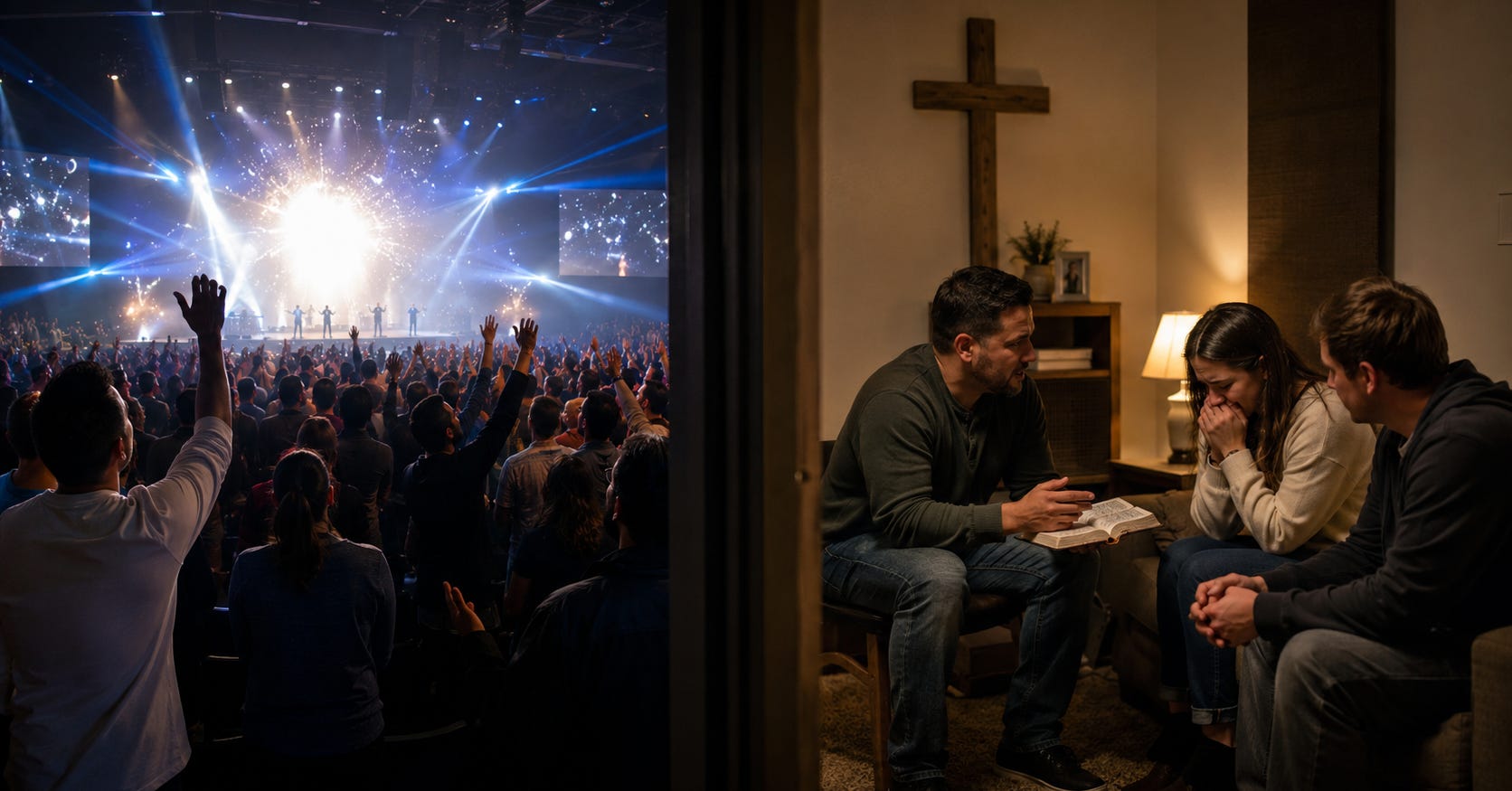
Picture two rooms. In the first, something happens that no one can explain. A dramatic moment, unmistakably outside the ordinary, the kind of thing that gets talked about for years afterward. In the second room, a man stands and, without spectacle of any kind, explains what happened on a Roman cross outside Jerusalem roughly two thousand years ago and why it matters. Which room, you would think, is more likely to produce a changed life?
Most people, if they are honest, would guess the first room. Spectacle grabs attention in a way plain explanation rarely does. And yet Scripture consistently points the opposite direction, which is worth sitting with rather than rushing past. Paul, writing to a church in a city obsessed with both spectacle and sophistication, described his approach with striking simplicity: “For I determined not to know anything among you except Jesus Christ and Him crucified” (1 Corinthians 2:2, NKJV). Not signs. Not demonstrations of power designed to impress. Christ, crucified, explained plainly.
Why would that be the strategy, if signs and wonders are so much more attention-grabbing? Because attention and conversion are not the same transaction. A sign can produce astonishment. It can produce a crowd. It can even produce temporary belief, the kind that shows up because something remarkable just happened and fades once the remarkable thing is no longer in front of them. But astonishment does not touch the actual problem a person has, which is not a lack of impressive experiences. It is a heart that needs to be changed, and changing a heart requires something that reaches deeper than the nervous system’s response to spectacle.
This is precisely why Paul could write, in the same letter, one of the more startling lines in the New Testament: “For Jews request a sign, and Greeks seek after wisdom; but we preach Christ crucified” (1 Corinthians 1:22-23, NKJV). Two entirely different audiences, wanting two entirely different things, both offered the same answer. Not a customized sign for the sign-seekers and a customized argument for the philosophers. The same message, regardless of what each audience thought it needed. That should tell you something about what the actual engine of conversion has always been. It was never the thing the audience was clamoring for.
Here is where this gets uncomfortable for anyone paying close attention to how faith actually spreads today. It is tempting to believe that the right dramatic moment would finally break through where careful explanation has failed, and tempting because it would be so much easier. A sign does the work for you. It removes the need to actually explain what the cross means, what sin is, why a substitute was required, and why this particular death accomplished what no other could. Explanation is slow and requires the listener to think rather than simply react. But explanation is also the only thing Scripture actually credits with the power to convert.
There is a category of teacher worth being cautious of here, not because their message is entirely false, but because it is mixed. Truth combined with error is more dangerous than error alone, precisely because the truth earns the trust that the error then exploits. A teacher who leans heavily on demonstration while treating the plain preaching of the cross as insufficient on its own has quietly reversed the priority Scripture establishes. The sign was never meant to be the message. At most, it was meant to get someone’s attention long enough to hear the message, which is itself the entire point.
This does not mean the miraculous has no place, or that anything unusual should be treated with suspicion by default. It means the unusual is not the thing doing the converting, and mistaking it for the thing doing the converting will eventually leave a person’s faith standing on the wrong foundation. A faith built on having witnessed something remarkable is only as stable as the next remarkable thing that comes along to challenge it. A faith built on understanding what happened at the cross, and why it was necessary, does not require a follow-up performance to keep standing.
Think about what this means for the ordinary work of trying to reach someone who does not yet believe. It is tempting to think the obstacle standing between them and faith is a lack of sufficiently compelling evidence, and that the right argument, the right undeniable moment, would finally make the resistance give way. But the obstacle was never primarily intellectual, and it was never primarily about the supply of evidence. It was a heart unwilling to reckon with its own condition, and hearts are not moved by evidence in the way that minds are moved by argument. They are moved by encountering something that exposes them and offers, in the same moment, a way through what has been exposed. That is precisely what the cross does, and it is not clear that anything else does it quite the same way.
This is also why patience matters more than most people expect it to. A sign can be delivered in a single dramatic moment. An explanation of the cross almost never works that way. It tends to unfold slowly, across conversations that do not feel especially remarkable while they are happening, planted in ordinary exchanges no one would think to record. The person doing the explaining rarely gets to see the moment it finally lands, and that absence of a visible payoff is part of what makes explanation feel like the weaker strategy, even though Scripture keeps insisting it is the one that actually works.
So here is the question worth carrying into the middle of the week. When you think about what actually moved you toward God, or what you hope might move someone you love toward Him, are you picturing a moment that stuns, or an explanation that lands? And if it is the first, what happens to that faith on the day the stunning moment is no longer available to lean on?
Focus Verse: “For Jews request a sign, and Greeks seek after wisdom; but we preach Christ crucified.” — 1 Corinthians 1:22-23 (NKJV)
Ready for Biblical Study That Goes Deeper Than Sunday School?
Join Truth Prospectors receiving systematic biblical teaching using Scripture-interpreting-Scripture methodology. No denominational filters. No shallow devotionals. Just the authority of God’s Word unlocking Christ’s complete ministry through the Sanctuary framework.
The Word Miner Ministries Resources
LISTEN to The Word Miner Podcast
Tired of surface-level Bible teaching? Join us as we tactically mine Scripture’s hidden treasures through sanctuary-based interpretation. Discover how systematic Bible study reveals Christ’s complete ministry and empowers you to unearth profound truths that denominational traditions often miss.

READ Our Daily Devotional: The Daily Shekinah Revival
Daily devotions restoring God’s glory within. A biblical devotional series that guides Truth Prospectors through daily encounters with God’s presence, using sanctuary typology and Scripture-centered teaching to restore authentic spiritual revival in the believer’s heart and life.

GET The Book: THE WAY: Discovering God’s Blueprint
What if the Bible’s key has been hidden in plain sight? Once you see it, Scripture will no longer seem scattered.
Sincere believers have pieced together disconnected verses, endured shallow teachings, and seen interpretations fail. The answer is the Biblical Sanctuary: God’s divine blueprint in Scripture from Genesis to Revelation. It’s not a human system but a pattern that unlocks prophecy, reveals Christ’s ministry, and turns fragmented knowledge into understanding.
LEARN The Core Pillars of Bible Study
Want to dig deeper into these truths? Explore The Core Pillars of Bible Study. Discover how Christ is the Center of all interpretation, why The Sanctuary is the Map for understanding God’s Word, and learn how Scripture is the Authority that interprets itself.
Connect With Us:
Find Us on Social Media:
Legal “Stuff”
© 2026 The Word Miner Ministries