

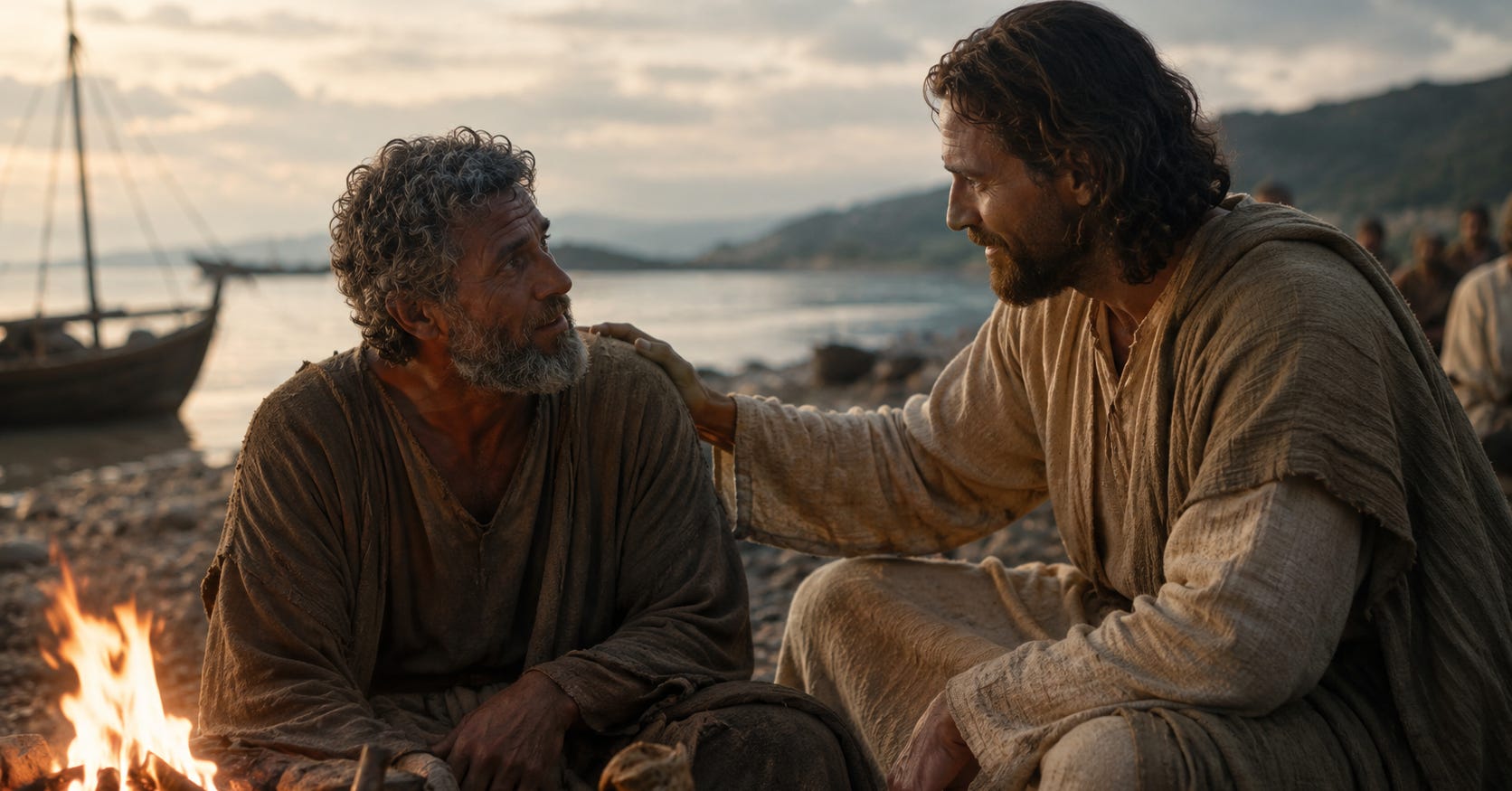
Peter recovered.
That is the end of the story, and it is important not to miss it in the weight of everything that came before it. The fall was real. The denial was real. The failure of the self-confidence that had assured him he would never stumble was complete and humiliating and deeply painful. But it was not the final word. Jesus had prayed for the faith not to fail ultimately, and the faith did not fail ultimately. Peter returned, and the return produced in him something the self-confidence never had: a genuine, tested, experienced dependence on Christ that was no longer theoretical.
But the recovery was not the point. The point was the cost of the path that made the recovery necessary.
If the week’s reading has accomplished anything, it has drawn a portrait of a specific kind of spiritual danger that most believers are not watching for because it does not look dangerous. The pride that presents itself as faith. The self-confidence that mistakes the memory of conversion for the present reality of dependence. The gradual drift that proceeds invisibly precisely because the confidence that should be directing the vigilance is instead directing it away. And underneath all of it, the heart that is not a reliable narrator of its own condition.
The answer the text provides is not a set of spiritual disciplines to perform in order to generate the right interior condition. It is the reorientation of trust toward the right object. “He who trusts in his own heart is a fool, but whoever walks wisely will be delivered” (Proverbs 28:26, NKJV). The walking wisely is not the product of superior self-knowledge. It is the fruit of the honest acknowledgment that the self is not a trustworthy guide and the corresponding choice to place the trust outside the self, in the One whose reliability is not a matter of the self’s assessment.
Paul describes the daily practice of this with a phrase that is easy to quote and genuinely costly to live: “I die daily” (1 Corinthians 15:31, NKJV). The daily dying is the daily ending of the self-reliance that would otherwise reassert itself as the primary operating principle. Not a single death at the beginning of the Christian life followed by a managed Christian existence. A daily returning to the posture of genuine dependence on Christ, a daily refusal to let the confidence in one’s own standing displace the active, present-tense reliance on the One who keeps the standing available.
This is not a heavy life. It is a light one, in the specific sense that Jesus described when He said His yoke was easy and His burden was light. The person carrying the yoke of self-reliance, monitoring their own performance and managing their own standing and defending their own confidence, is carrying something heavy. The person who has transferred the weight to the One who said He would carry it is carrying something very different. The constant distrust of self is not a burden added to the Christian life. It is the releasing of the burden that self-reliance had imposed. And the freedom on the other side of that release is what no amount of self-confident spiritual management could have produced.
And Galatians 6:1 provides the outward expression of this inward posture: “considering yourself lest you also be tempted” (NKJV). The considering yourself is not morbid introspection. It is the accurate self-awareness that keeps a person from the confident condescension that failed Peter. The person who remembers accurately what they are capable of on their own terms is the person most positioned to maintain the dependence that prevents Peter’s problem from becoming their own.
The full picture the week has been building toward is this. Pride is the most dangerous spiritual condition not because it is the worst on the list but because it is the one that prevents its own treatment. The gradual fall is the most threatening kind of fall not because it ends worse but because it is the least visible until it has arrived. And the constant distrust of self and dependence on Christ is the least comfortable sounding remedy but the one that actually holds, because it is the posture in which the grace that keeps the believing soul free from sin operates at its full capacity. The entire arrangement works when the person inside it maintains the honest, daily posture of someone who knows they need it.
Peter learned this. He learned it at significant cost, at a fire in a courtyard, in the bitterest moment of his discipleship. The grace of it is that we do not have to pay the same tuition for the same lesson. The story is there, in all its painful clarity, so that the lesson can be absorbed before the fire in the courtyard rather than beside it.
Focus Verse: "For it is God who works in you both to will and to do for His good pleasure." — Philippians 2:13 (NKJV)
Ready for Biblical Study That Goes Deeper Than Sunday School?
Join Truth Prospectors receiving systematic biblical teaching using Scripture-interpreting-Scripture methodology. No denominational filters. No shallow devotionals. Just the authority of God’s Word unlocking Christ’s complete ministry through the Sanctuary framework.
The Word Miner Ministries Resources
LISTEN to The Word Miner Podcast
Tired of surface-level Bible teaching? Join us as we tactically mine Scripture’s hidden treasures through sanctuary-based interpretation. Discover how systematic Bible study reveals Christ’s complete ministry and empowers you to unearth profound truths that denominational traditions often miss.

READ Our Daily Devotional: The Daily Shekinah Revival
Daily devotions restoring God’s glory within. A biblical devotional series that guides Truth Prospectors through daily encounters with God’s presence, using sanctuary typology and Scripture-centered teaching to restore authentic spiritual revival in the believer’s heart and life.

GET The Book: THE WAY: Discovering God’s Blueprint
What if the Bible’s key has been hidden in plain sight? Once you see it, Scripture will no longer seem scattered.
Sincere believers have pieced together disconnected verses, endured shallow teachings, and seen interpretations fail. The answer is the Biblical Sanctuary: God’s divine blueprint in Scripture from Genesis to Revelation. It’s not a human system but a pattern that unlocks prophecy, reveals Christ’s ministry, and turns fragmented knowledge into understanding.
LEARN The Core Pillars of Bible Study
Want to dig deeper into these truths? Explore The Core Pillars of Bible Study. Discover how Christ is the Center of all interpretation, why The Sanctuary is the Map for understanding God’s Word, and learn how Scripture is the Authority that interprets itself.
CONNECT WITH US:
Find Us on Social Media:
Legal “Stuff”
© 2026 The Word Miner Ministries