

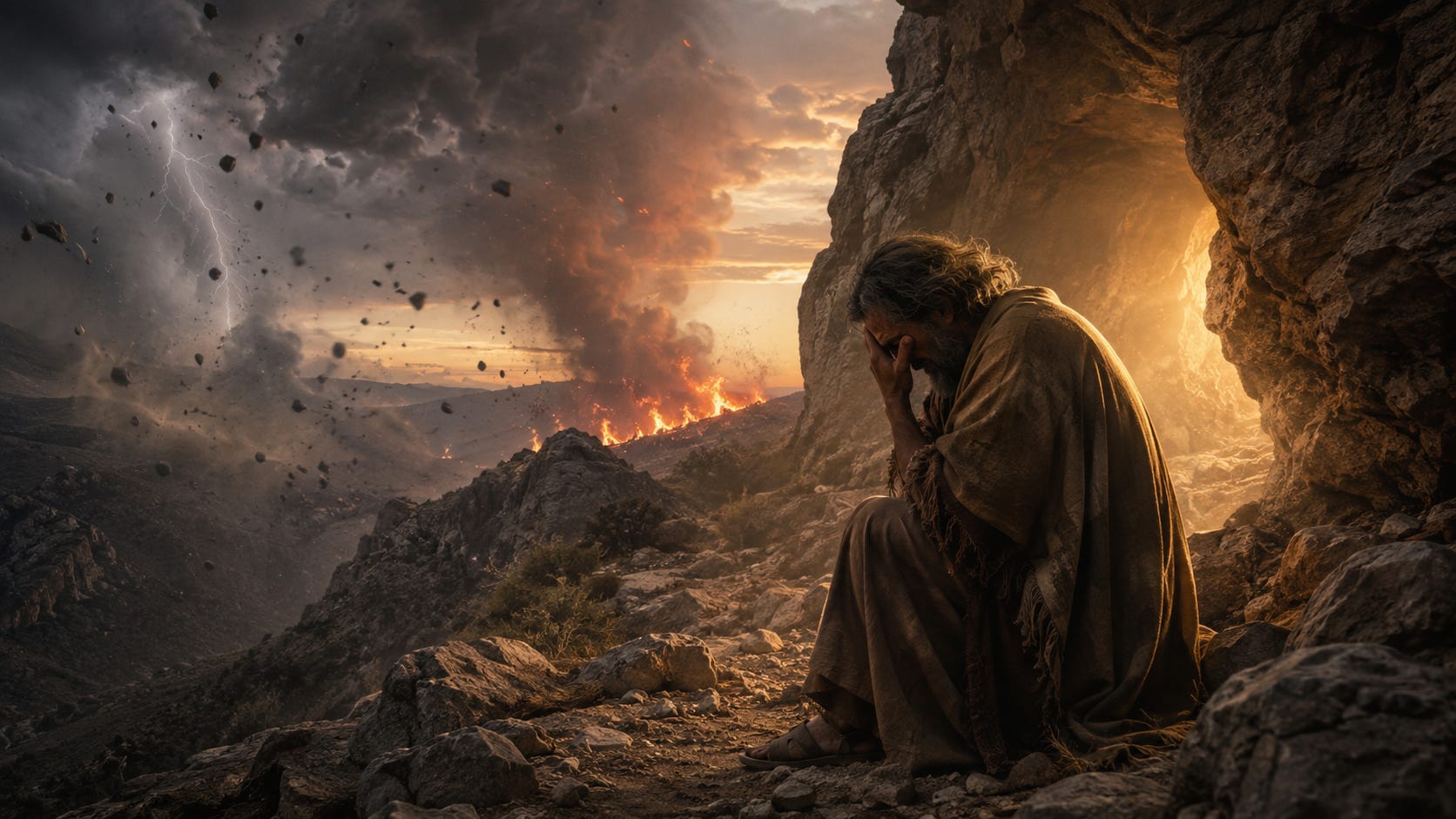
Here’s a scene worth sitting with before the week gets away from you. A prophet stands on a mountain, exhausted, half convinced his work has failed, and he is told to wait, because the Lord is about to pass by. What happens next reads almost like a checklist of everything a person might expect God’s presence to look like. A wind comes, strong enough to tear the mountains apart and break rocks in pieces. Then an earthquake. Then a fire. Three consecutive, unmistakable, overwhelming displays of power, arriving one after another in front of a man who badly needed to know God was still with him.
And in each case, the text says something that ought to stop a careful reader cold: the Lord was not in it. Not in the wind. Not in the earthquake. Not in the fire. After all three had passed came a still small voice, and it was there, in that hush, that Elijah finally covered his face, because he understood he was standing in front of something real “a still small voice. So it was, when Elijah heard it, that he wrapped his face in his mantle” (1 Kings 19:12-13, NKJV).
Think about what that account is actually claiming. It is not claiming that wind, earthquakes, and fire are fake or theatrical. They are real, forceful, terrifying phenomena, the kind that would leave anyone shaken. The claim is stranger than that. It is that raw power and divine presence are not the same thing, and a person standing in the middle of something overwhelming cannot simply assume God is the one producing it.
That should unsettle anyone who has ever measured a spiritual moment by how much it shook them. The instinct runs the other direction almost automatically. Something loud happens, something forceful, something that overrides the ordinary quiet of a room, and the mind reaches for the nearest explanation strong enough to match the intensity of the experience. Surely something this large has to be God. But Elijah had already watched three enormous displays pass by without God in any of them, and if that pattern held on Horeb, there is no reason to assume it stopped there.
Paul, writing to a church that had real spiritual gifts operating in the middle of real confusion about how to use them, landed on a description of God’s presence that sounds almost anticlimactic next to wind and fire: “God is not the author of confusion but of peace” (1 Corinthians 14:33, NKJV). Not the author of spectacle. Not the author of overwhelming sensory experience for its own sake. The author of peace, and by implication, wherever confusion is multiplying rather than settling, something other than that peace is doing the producing.
This does not mean intensity is automatically suspect, any more than the wind and earthquake on Horeb were suspect simply for being large. It means intensity was never the qualifying test to begin with, and treating it as one leaves a person vulnerable to being moved by exactly the kind of thing Elijah watched pass by without God in it. A room can be loud, chaotic, physically overwhelming, and still have nothing to do with the quiet presence Elijah eventually recognized. And a room can be still, unremarkable, almost boring by comparison, and be exactly where God has chosen to show up.
Here is what makes this more than an interesting detail about one prophet’s experience on one particular day. The same instinct that reached for wind, earthquake, and fire as proof of divine nearness is the same instinct still operating whenever a person assumes that the most overwhelming moment in a room must be the most spiritual one. Paul gave the Corinthians a practical filter for exactly this instinct: “Let all things be done decently and in order” (1 Corinthians 14:40, NKJV). Order, not chaos. Decency, not spectacle. Those words sound almost administrative sitting next to wind and fire, and that is precisely the point. What actually carries divine weight rarely announces itself the way a person expects.
So what does a person do with an instinct this deeply wired in, the one that keeps reaching for the loudest explanation available? Probably not extinguish it entirely; overwhelming experiences are still real experiences, and dismissing every strong moment as automatically empty would be its own kind of mistake. But the instinct needs a check it was never going to supply for itself, because by its nature it always votes for whatever produced the biggest sensation, regardless of what actually caused it.
That is why Elijah’s story matters more than a single memorable scene from an old narrative. It is a record of someone learning, in real time, that his own assumption about where to look was wrong three times in a row before it was finally right. If a prophet standing on the mountain where God had already spoken before could misjudge that badly, the confidence with which anyone else assumes they would have recognized the wind and the fire as false, and the whisper as true, deserves a second look.
What was the last spiritual moment you assumed carried weight because of how much it overwhelmed you, and would it have still felt significant if it had arrived instead as a hush you almost missed?
Focus Verse: “And after the fire a still small voice. So it was, when Elijah heard it, that he wrapped his face in his mantle.” — 1 Kings 19:12-13 (NKJV)
Ready for Biblical Study That Goes Deeper Than Sunday School?
Join Truth Prospectors receiving systematic biblical teaching using Scripture-interpreting-Scripture methodology. No denominational filters. No shallow devotionals. Just the authority of God’s Word unlocking Christ’s complete ministry through the Sanctuary framework.
The Word Miner Ministries Resources
LISTEN to The Word Miner Podcast
Tired of surface-level Bible teaching? Join us as we tactically mine Scripture’s hidden treasures through sanctuary-based interpretation. Discover how systematic Bible study reveals Christ’s complete ministry and empowers you to unearth profound truths that denominational traditions often miss.

READ Our Daily Devotional: The Daily Shekinah Revival
Daily devotions restoring God’s glory within. A biblical devotional series that guides Truth Prospectors through daily encounters with God’s presence, using sanctuary typology and Scripture-centered teaching to restore authentic spiritual revival in the believer’s heart and life.

GET The Book: THE WAY: Discovering God’s Blueprint
What if the Bible’s key has been hidden in plain sight? Once you see it, Scripture will no longer seem scattered.
Sincere believers have pieced together disconnected verses, endured shallow teachings, and seen interpretations fail. The answer is the Biblical Sanctuary: God’s divine blueprint in Scripture from Genesis to Revelation. It’s not a human system but a pattern that unlocks prophecy, reveals Christ’s ministry, and turns fragmented knowledge into understanding.
LEARN The Core Pillars of Bible Study
Want to dig deeper into these truths? Explore The Core Pillars of Bible Study. Discover how Christ is the Center of all interpretation, why The Sanctuary is the Map for understanding God’s Word, and learn how Scripture is the Authority that interprets itself.
Connect With Us:
Find Us on Social Media:
Legal “Stuff”
© 2026 The Word Miner Ministries