

You have probably sat in a room where something was being called a move of God, and some part of you, underneath the raised hands and the noise, felt only louder and no more sure. The room was shaking with something. People were on the floor. Someone was crying into a microphone. And you stood there running your own quiet audit — is this Him, or is this just what a crowd does when it’s given permission to feel something together — and hated yourself a little for asking.
Confusion has a way of dressing up as intensity. The louder a room gets, the more certain everyone inside it seems that something is finally happening. If you’ve ever walked out of a service like that feeling more scattered than when you walked in, wrung out instead of filled, embarrassed instead of moved, you may have quietly decided that either something is wrong with the room, or something is wrong with you. Most people, given that choice, assume it’s them.
It might be neither. It might be a category error nobody ever corrected for you: the assumption that God’s presence is measured by the volume of the room He’s in.
Maybe it wasn’t even a service. Maybe it was a season — the year everything seemed to fall apart at once, one crisis stacked on another, and somewhere in the middle of surviving it you decided the sheer intensity of what you were carrying must mean God was doing something enormous on your behalf, working overtime because the stakes were finally high enough to earn His attention. It is a natural thing to believe. It is also not how He has ever operated, on a lake or anywhere else the text records Him showing up.
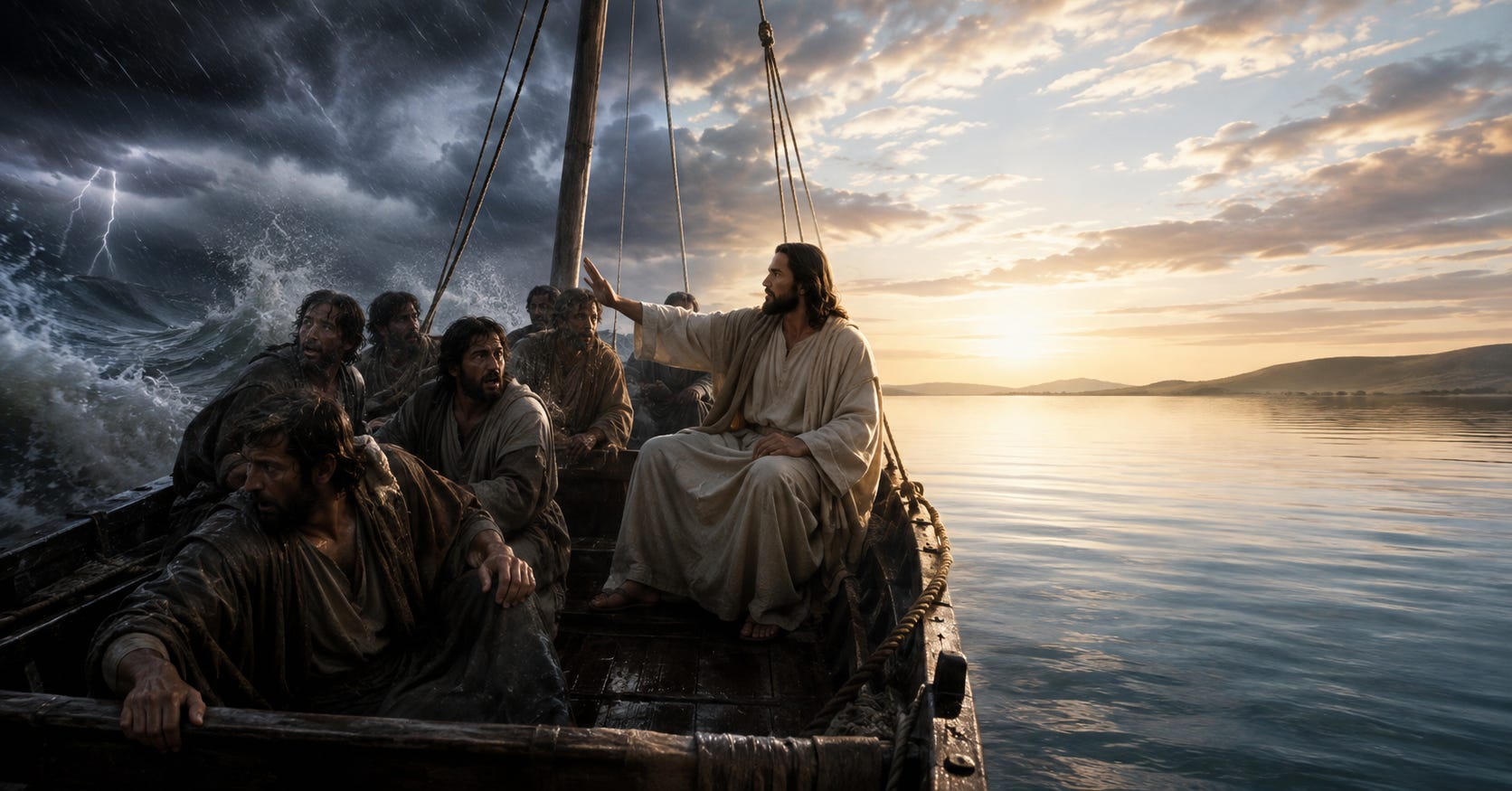
There is a night on a lake that answers this directly, and it is worth noticing how little patience the text has for spectacle. The disciples are in a boat, a storm has come up hard enough that experienced fishermen think they are going to drown, and Christ is in the stern, asleep. Not performing calm. Actually asleep, through wind loud enough to be swamping the boat. They wake Him with something close to an accusation — “Teacher, do You not care that we are perishing?” (Mark 4:38, NKJV) — and He gets up, and He does not shout the storm down to match it. He speaks to it. “Peace, be still!” (Mark 4:39, NKJV). Two words to a sea. And the wind stops, and there is a great calm, and He turns to the men still gripping the sides of the boat and asks them why they were so afraid, why they still had no faith (Mark 4:40, NKJV).
Watch what actually happened in that boat. The chaos was not the presence of God arriving. The chaos was what was already there before He spoke. His presence was the end of the chaos, not its source.
He did not need to match the storm’s volume to be stronger than it.
This is not incidental to who He is. It goes back further than that lake, to a formless deep with darkness over its face and no shape to anything yet, and “the Spirit of God was hovering over the face of the waters. Then God said, ‘Let there be light’; and there was light” (Genesis 1:2-3, NKJV). Speech, not spectacle, turning a chaos with no form into a world with order. The same pattern runs from that first morning to that lake centuries later: wherever He shows up, the noise starts settling, not rising.
Order is not the absence of His Spirit.
Order is what tends to happen once He’s actually in the room.
“Let all things be done decently and in order” (1 Corinthians 14:40, NKJV) is not a rule about church services written by a distant committee. It is a description of His character, confirmed on a lake centuries after it was already true at creation. If a room, a season, a whole year of your life has felt like nothing but swirling water and you assumed the swirling itself must be Him doing something, you may have been crediting the storm for a presence that only ever shows up once the storm stops.
That does not mean God is only found in stillness, or that every quiet room is automatically holy. A becalmed life can simply mean nothing is happening at all, no more spiritual than a storm that never got named as one. Stillness is not the test, any more than noise was. He is the test — whether a room, a season, a decision actually traces back to Him speaking, or only borrowed His name after the fact because something dramatic needed an explanation.
Somewhere you may still be standing in that boat, soaked, watching the water for the next wave, waiting to feel something big enough to trust — when the actual proof already spoke two words and went back to sleep.
What would it take for you to trust the calm as much as you’ve been trusting the storm?
Focus Verse: “Then He arose and rebuked the wind, and said to the sea, ‘Peace, be still!’ And the wind ceased and there was a great calm.” — Mark 4:39 (NKJV)
Reflection Question: Think of a specific “chaotic” spiritual experience you once treated as proof God was moving. Write down what actually happened afterward — did it produce lasting peace and clarity, or did it fade into more confusion? What would it look like to test that memory against Christ’s own words in Mark 4:39 instead of against how intense it felt in the moment?
Ready for Biblical Study That Goes Deeper Than Sunday School?
Join Truth Prospectors receiving systematic biblical teaching using Scripture-interpreting-Scripture methodology. No denominational filters. No shallow devotionals. Just the authority of God’s Word unlocking Christ’s complete ministry through the Sanctuary framework.
The Word Miner Ministries Resources
LISTEN to The Word Miner Podcast
Tired of surface-level Bible teaching? Join us as we tactically mine Scripture’s hidden treasures through sanctuary-based interpretation. Discover how systematic Bible study reveals Christ’s complete ministry and empowers you to unearth profound truths that denominational traditions often miss.

READ Our Daily Devotional: The Daily Shekinah Revival
Daily devotions restoring God’s glory within. A biblical devotional series that guides Truth Prospectors through daily encounters with God’s presence, using sanctuary typology and Scripture-centered teaching to restore authentic spiritual revival in the believer’s heart and life.

GET The Book: THE WAY: Discovering God’s Blueprint
What if the Bible’s key has been hidden in plain sight? Once you see it, Scripture will no longer seem scattered.
Sincere believers have pieced together disconnected verses, endured shallow teachings, and seen interpretations fail. The answer is the Biblical Sanctuary: God’s divine blueprint in Scripture from Genesis to Revelation. It’s not a human system but a pattern that unlocks prophecy, reveals Christ’s ministry, and turns fragmented knowledge into understanding.
LEARN The Core Pillars of Bible Study
Want to dig deeper into these truths? Explore The Core Pillars of Bible Study. Discover how Christ is the Center of all interpretation, why The Sanctuary is the Map for understanding God’s Word, and learn how Scripture is the Authority that interprets itself.
Connect With Us:
Find Us on Social Media:
Legal “Stuff”
© 2026 The Word Miner Ministries