

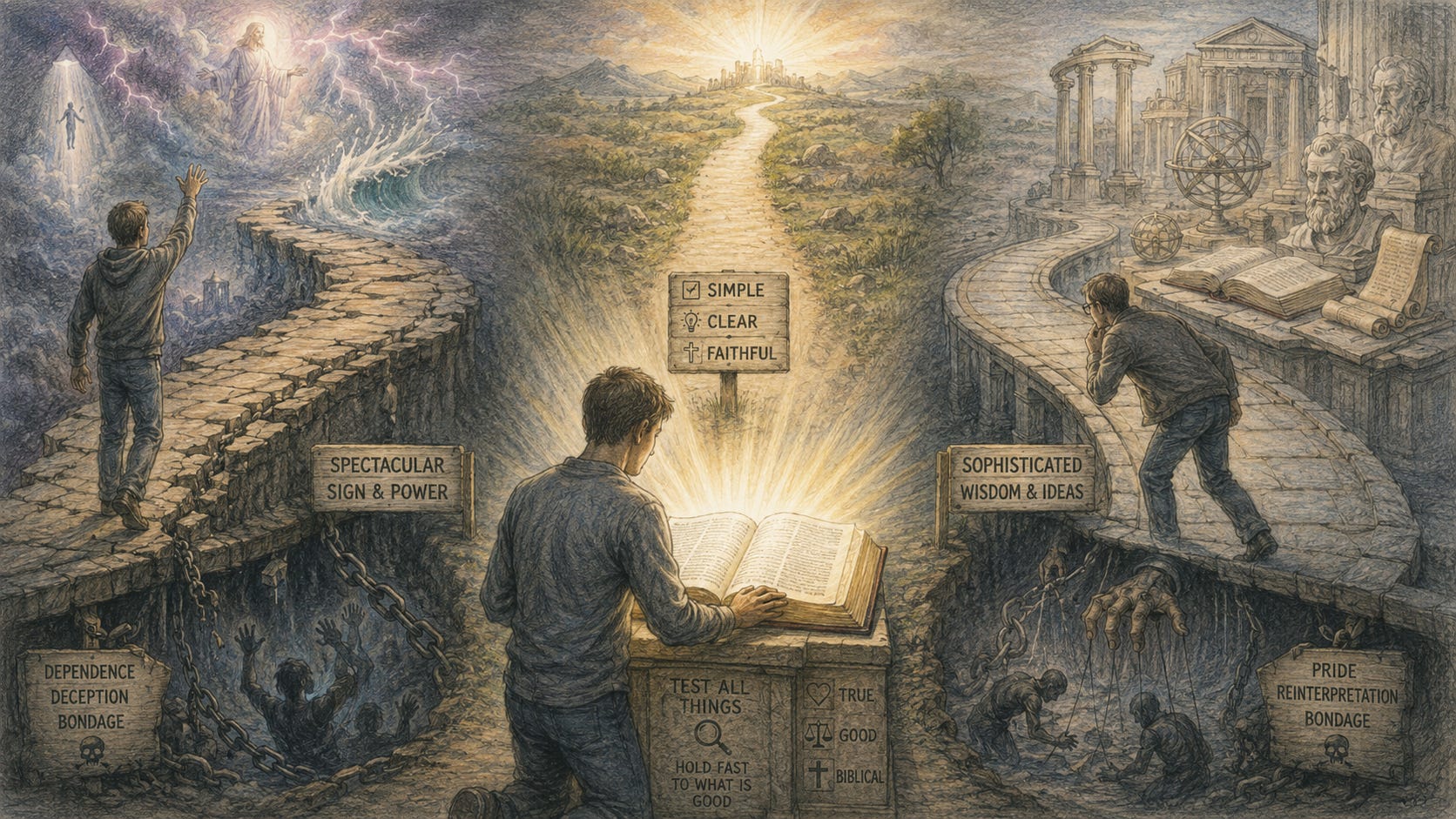
Monday and Tuesday describe two different-looking problems with a common destination.
The person who makes miracles the test of faith looks different from the person who gives heed to subtle fallacies that gradually darken the understanding of Scripture. The first is oriented toward the experiential and the spectacular. The second may be oriented toward the intellectual and the sophisticated. Their temperaments are different, their vulnerabilities are different, the specific form of the incoming deception is different for each of them. But both of them arrive at the same place: believing something that is not true, based on something other than the plain word of God, while being confident that what they believe is sound.
This is the structure the enemy works within. He is not running a single strategy. He is running a portfolio of strategies, each calibrated to the specific vulnerabilities of specific kinds of people. The person who mistrusts intellectualism and is drawn to visible signs of power gets the miracle. The person who is sophisticated and finds plain reading too simplistic gets the subtle philosophical supplement that relocates meaning to somewhere more comfortable. Both strategies are aimed at the same target: the authority of the plain word of God in the individual believer’s actual decision-making.
“There is a way that seems right to a man, but its end is the way of death” (Proverbs 14:12, NKJV). The way that seems right is not the way that is obviously wrong. The way that seems right is the way that carries the feeling of validity — experiential validity for the miracle-follower, intellectual validity for the subtle-fallacy recipient. The feeling of being on the right path is not evidence that the path leads where it seems to lead. The feeling can be produced by both paths, regardless of the destination each reaches.
What both paths share is the displacement of the word as the final authority. In the miracle case, the displacement is direct: the miracle overrides the word. If something supernatural happened, the word’s contrary teaching is either reinterpreted to accommodate the miracle or quietly set aside. In the subtle fallacy case, the displacement is gradual: the word is not rejected but progressively reinterpreted through external frameworks until its plain meaning has been replaced by a more palatable alternative that happens to agree with what the believer wanted it to say.
“And you shall know the truth, and the truth shall make you free” (John 8:32, NKJV). The freedom promised here is the freedom from exactly the kind of bondage both Monday and Tuesday have been describing: bondage to a convincing but false version of reality. The truth makes free not through the emotional experience of liberation but through the actual alignment of the believer’s understanding with what is actually true, which requires the actual plain word as the source of that understanding.
The preparation the text calls for — arming for the contest — is preparation against both forms of the attack simultaneously. Not against miracles as such, but against the use of miracles as a replacement for scriptural testing. Not against nuance and depth as such, but against the use of apparent sophistication as a reason to move away from the plain sense of the text toward something more intellectually fashionable. The armor protects against both because the armor is the same in both cases: the word of God, prayerfully studied, practically applied, held to be the final test of every statement and every miracle, regardless of how the statement arrives or how impressive the miracle is.
The two roads look different. They lead to the same trap. And the same shield guards against both.
What this means practically is that the preparation the text calls for is not a targeted defense against one specific form of deception. It is the comprehensive formation of a person whose interior life is so consistently oriented toward the plain word of God that the deception — regardless of which road it takes — encounters something already in place that it cannot displace. The miraculous sign arrives, and the person’s first instinct is the text, not the feeling. The subtle philosophical reframe arrives, and the person’s first instinct is the plain sense of Scripture, not the sophisticated alternative. In both cases, the test is applied before the verdict is rendered, and the test is the same test applied in both cases.
This is why the text does not prescribe a different response to the miracle-trap than it prescribes to the subtle-fallacy trap. The response in both cases is to return to the word. To the law and to the testimony. If it does not speak according to this word, the form of its arrival and the impressiveness of its credentials are irrelevant to the verdict. The test is simple. The test is consistent. The test is the same in every situation the week has described, and its simplicity is itself part of the protection — because the enemy’s most effective tools are sophisticated, and the thing that defeats sophistication is not greater sophistication but a simple, settled, unwavering standard.
Focus Verse: “There is a way that seems right to a man, but its end is the way of death.” — Proverbs 14:12 (NKJV)
Ready for Biblical Study That Goes Deeper Than Sunday School?
Join Truth Prospectors receiving systematic biblical teaching using Scripture-interpreting-Scripture methodology. No denominational filters. No shallow devotionals. Just the authority of God’s Word unlocking Christ’s complete ministry through the Sanctuary framework.
The Word Miner Ministries Resources
LISTEN to The Word Miner Podcast
Tired of surface-level Bible teaching? Join us as we tactically mine Scripture’s hidden treasures through sanctuary-based interpretation. Discover how systematic Bible study reveals Christ’s complete ministry and empowers you to unearth profound truths that denominational traditions often miss.

READ Our Daily Devotional: The Daily Shekinah Revival
Daily devotions restoring God’s glory within. A biblical devotional series that guides Truth Prospectors through daily encounters with God’s presence, using sanctuary typology and Scripture-centered teaching to restore authentic spiritual revival in the believer’s heart and life.

GET The Book: THE WAY: Discovering God’s Blueprint
What if the Bible’s key has been hidden in plain sight? Once you see it, Scripture will no longer seem scattered.
Sincere believers have pieced together disconnected verses, endured shallow teachings, and seen interpretations fail. The answer is the Biblical Sanctuary: God’s divine blueprint in Scripture from Genesis to Revelation. It’s not a human system but a pattern that unlocks prophecy, reveals Christ’s ministry, and turns fragmented knowledge into understanding.
LEARN The Core Pillars of Bible Study
Want to dig deeper into these truths? Explore The Core Pillars of Bible Study. Discover how Christ is the Center of all interpretation, why The Sanctuary is the Map for understanding God’s Word, and learn how Scripture is the Authority that interprets itself.
Connect With Us:
Find Us on Social Media:
Legal “Stuff”
© 2026 The Word Miner Ministries