

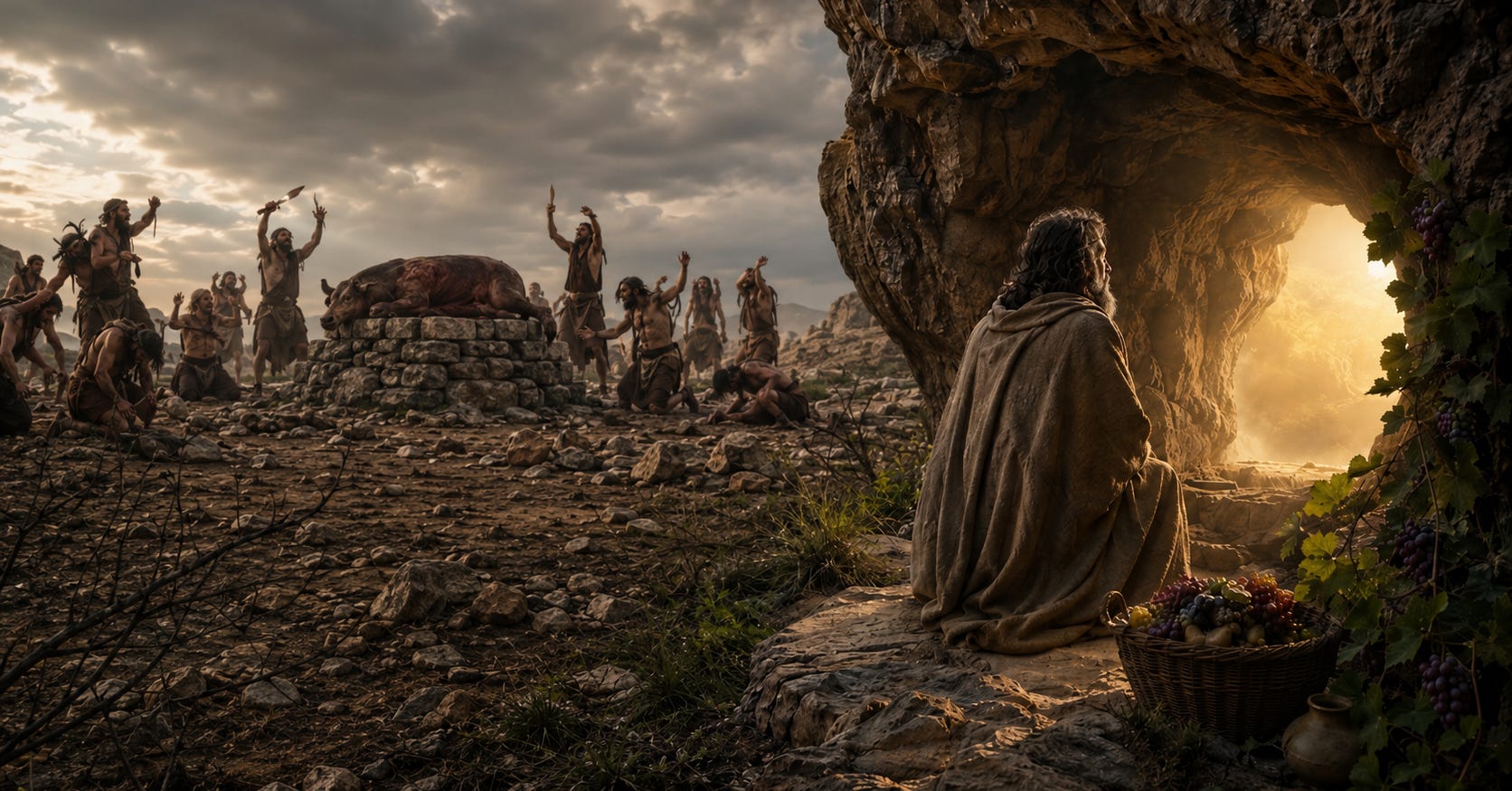
Two scenes from the same stretch of Scripture, sitting only a chapter apart, look almost nothing alike on the surface. One is a mountaintop full of noise, blood, and desperate escalation, prophets working themselves into exhaustion trying to provoke a response from a god who was never going to answer. The other is a quiet cave, a battered prophet waiting for wind and earthquake and fire to pass by before finally recognizing God’s presence in something closer to silence. Different volume, different setting, different emotional register entirely. And yet underneath the surface, both scenes were testing for the exact same thing.
The prophets of Baal assumed volume and intensity would eventually produce a response, so they kept adding more of both, right up to the point of drawing their own blood. Elijah, without meaning to, initially assumed something similar, expecting the Lord to show up in whichever of the three overwhelming displays turned out to be the right one. Both assumptions were wrong in the same direction. Both treated intensity as the variable that mattered, when the actual variable, all along, was something closer to what Paul later described plainly: “God is not the author of confusion but of peace” (1 Corinthians 14:33, NKJV).
That connects to something easy to miss the first time through, which is what Jesus actually said to look for when trying to sort a real thing from a counterfeit one. Not, how did it feel. Not, how much of yourself did you lose in the process. “You will know them by their fruits. Do men gather grapes from thornbushes or figs from thistles?” (Matthew 7:16, NKJV). Fruit is not the noise of the harvest. It is not the sensation of gathering it. It is what remains afterward, what can actually be carried away and used to feed someone, long after the moment of picking has passed.
Put the two scenes back together with that standard in view, and the connection becomes clearer than either one offered on its own. What the prophets of Baal produced, for all their effort, was exhaustion and silence, nothing that outlasted the display itself. What Elijah eventually recognized, in the quiet after the noise had passed, was instruction, a clear word he could carry down the mountain and act on. One scene produced fruit. The other, despite every outward marker of intensity, produced nothing at all.
This is where the earlier question about self-control fits into the same frame. Paul’s description of what the Spirit actually cultivates in a person over time reads like a list built for durability rather than spectacle: “love, joy, peace, longsuffering, kindness, goodness, faithfulness, gentleness, self-control” (Galatians 5:22-23, NKJV). Every item on that list describes something that has to survive past the moment it first appears in order to count as fruit at all. Peace that only lasts as long as the loud room does is not peace in the sense Paul means. Self-control that vanishes the instant intensity arrives was never really self-control, only its temporary appearance.
Here is what makes this more than two separate observations loosely stitched together. Both the noise on one mountain and the wind, earthquake, and fire on the other were, in their own way, distractions from the same underlying test. Not, did something happen that could not be ignored. Almost anything intense enough clears that bar. The actual test was always whether what happened produced fruit that could be carried forward, examined later, and found to still be standing once the intensity that produced it had faded completely.
Think about how often this same test would need to be applied outside of Scripture’s own examples, in the far less dramatic settings most people actually live in. A conversation that leaves someone impressed in the moment but changes nothing about how they treat the person they go home to that night. A season of enthusiasm about a new practice or teacher that fades within a month once the initial excitement wears off. A gathering that felt unmistakably alive while it was happening and produced, on reflection, nothing anyone could point to a week later beyond the memory of having been there. None of these examples involve prophets, mountains, or ancient altars, and none of them need to. The same test applies at whatever scale the moment happens to occur.
That reframes what to watch for the next time an experience presents itself as unmistakably significant simply because it could not be ignored in the moment. The prophets of Baal could not be ignored either. Neither could the wind that tore the mountain apart before Elijah realized God was not in it. Being impossible to ignore was never the qualification. It never had been. What actually qualified was quieter, slower to notice, and considerably harder to fake over any real length of time.
So the question worth carrying forward is not simply which of the two scenes felt more relevant to your own experience, the noise or the quiet. It is whether either kind of moment, loud or still, left behind something you could still point to a week later. If nothing remains once the intensity fades, in either direction, it was never really about volume in the first place. What has actually lasted, in your own life, once the moment that produced it had gone completely quiet?
Focus Verse: “You will know them by their fruits. Do men gather grapes from thornbushes or figs from thistles?” — Matthew 7:16 (NKJV)
Ready for Biblical Study That Goes Deeper Than Sunday School?
Join Truth Prospectors receiving systematic biblical teaching using Scripture-interpreting-Scripture methodology. No denominational filters. No shallow devotionals. Just the authority of God’s Word unlocking Christ’s complete ministry through the Sanctuary framework.
The Word Miner Ministries Resources
LISTEN to The Word Miner Podcast
Tired of surface-level Bible teaching? Join us as we tactically mine Scripture’s hidden treasures through sanctuary-based interpretation. Discover how systematic Bible study reveals Christ’s complete ministry and empowers you to unearth profound truths that denominational traditions often miss.

READ Our Daily Devotional: The Daily Shekinah Revival
Daily devotions restoring God’s glory within. A biblical devotional series that guides Truth Prospectors through daily encounters with God’s presence, using sanctuary typology and Scripture-centered teaching to restore authentic spiritual revival in the believer’s heart and life.

GET The Book: THE WAY: Discovering God’s Blueprint
What if the Bible’s key has been hidden in plain sight? Once you see it, Scripture will no longer seem scattered.
Sincere believers have pieced together disconnected verses, endured shallow teachings, and seen interpretations fail. The answer is the Biblical Sanctuary: God’s divine blueprint in Scripture from Genesis to Revelation. It’s not a human system but a pattern that unlocks prophecy, reveals Christ’s ministry, and turns fragmented knowledge into understanding.
LEARN The Core Pillars of Bible Study
Want to dig deeper into these truths? Explore The Core Pillars of Bible Study. Discover how Christ is the Center of all interpretation, why The Sanctuary is the Map for understanding God’s Word, and learn how Scripture is the Authority that interprets itself.
Connect With Us:
Find Us on Social Media:
Legal “Stuff”
© 2026 The Word Miner Ministries